


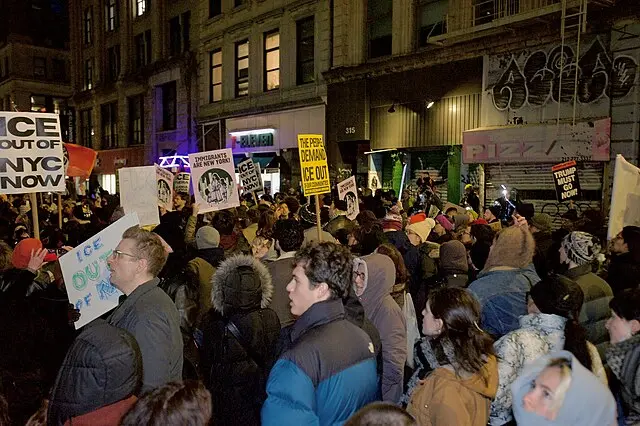
The killing of Renee Good by an ICE officer in Minneapolis on 7th January 2026 has rapidly become a defining flashpoint in Trump’s second term, displaying the collision between a rapidly expanded and heavily funded enforcement state and the lives caught beneath it. Good, a 37 year old mother of three, an award-winning poet, was sitting in her car when ICE vehicles boxed her in on a Minneapolis street as part of a ‘targeted operation’. Agents quickly surrounded her car in tactical gear, shouting at her to get out. When she tried to maneuver away, an agent stepped to the side of her SUV, drew his handgun and fired three rounds through the driver’s side window and the hood, killing her within minutes.
Quickly, the administration moved to impose its own narrative. Homeland Security officials claimed that Good had attempted to ram federal officers with her vehicle, despite the official footage released clearly showed the officers being out of range for her to ram them with her car. Top officials, including Kristi Noem and Donald Trump himself labelling her as a ‘terrorist’ and hailing the shooting as evidence that the government would not ‘back down’ in the face of domestic threats.
This incident comes amid a massive expansion of ICE’s footprint, funnelling tens of billions of dollars into new officers, detention centres and high visibility street operations especially in Democratic-run cities. Masked ICE officers have increasingly become a commonplace sight outside workplaces, schools and courthouses.
Politically, the damage has been done. Footage of agents firing into a passing car has undercut the administration’s claim of imminent danger, while the rush to denounce Renee Good as a domestic terrorist has reinforced the perception of an administration more interested in crushing dissent than protecting life. This episode has once again raised to the fore the question, how much lethal force is the state prepared to unleash in the name of immigration and at what point does ‘enforcement’ slide into open intimidation of the public it claims to defend?
