


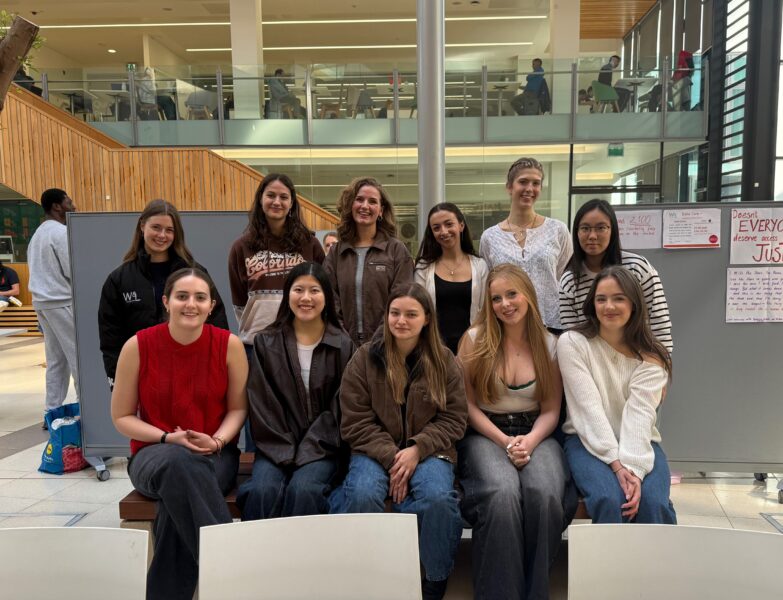
Despite its misleading name, Women & Law at the University of Exeter is not a society just for women. “This really is for everybody,” says Caitlin Amos, last year’s pro bono officer, who is keen to expel the assumption that men are not welcome in the society. Both of its application forms state that you do not need to be a woman to apply, and every opportunity is free. For students that are money conscious, this is an easy sell.
Caitlin now heads both the Amicus ALJ Law Clinic and the Citizens Advice Hub, which both run in partnership with the society. Men are as welcome as women, irrespective of if they study law or not. She sees the work the society does as a way of removing barriers to the legal profession, and a price of £0 is part of that. “There is always room to do more,” she says eagerly.
Men are as welcome as women, irrespective of whether they study law or not.
This eagerness is underpinned by the clinic’s work. This has included work on the Missouri Project, which examines death penalty cases in the United States. Missouri limited capital punishment to the “worst of the worst” defendants, and caseworkers help test whether that is what happens in practice or whether the penalty is applied disproportionately, especially by the race of defendants and victims. The impact of Women & Law beyond the seminar room, which, as a law student myself, can at times feel rather monotonous, which is not to jab at the course, rather the nature of education against an internship or volunteering stint, is profound.
Alongside the Amicus ALJ Clinic is the work Women & Law does with Citizens Advice offices in the South West. Team members research and propose reform on problems that local people have been suffering with, including the Renters’ Rights Act 2025, and restorative justice. The findings could go on to inform lobbying, such as in the energy market and consumer protection.
Both projects run in Terms 1 and 2, with nothing expected over holidays or exam periods. Both inevitably lead somewhere if successful with the applications. There is a clear and likely progression within Amicus ALJ and Citizens Advice when working within the Women & Law framework, allowing individuals to gain even more experience in the world of law; skills highly sought after by graduate employers.
The work of the society has been recognised. After self-nomination, it was shortlisted twice at the 2026 Guild Awards, including for the Collaboration Award. Woman & Law was again shortlisted for the Attorney General’s Student Pro Bono Awards at the House of Lords, which only serves to underpin the national recognition the society has received. Since our conversation, they have been shortlisted for the Champion Academic Team at the Amicus Champions of Justice Awards 2026, a testament to both their significance and mouthfuls in pro bono.
Speaking of pro bono, Caitlin highlights how uncommon such initiatives are among student societies, and she asks what others are doing to represent communities affected by pro bono shortfalls, including which specific voids they are filling. Raising awareness is the other challenge, because promoting the society beyond a female audience is difficult. Her sentiment is straight forward, though with a ‘do it, don’t say’ attitude, letting real-world experience speak for itself.
As law students, or even as non-law students, everyone has things on their plate. If you have a few hours to spare and an interest in the law, this door is open, and Caitlin emphasised this throughout our chat. It costs nothing, the experience is real and is for everybody.
