
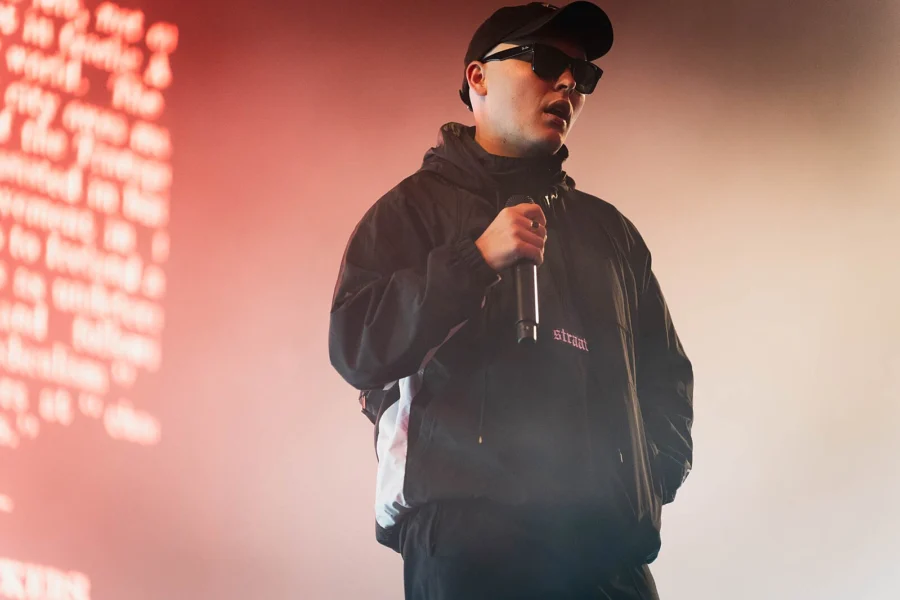
Irish hip-hop trio Kneecap, known for their Irish-language lyricism and bold political resistance, have become the centre of international controversy following recent legal charges pressed against one of their members.
Liam Óg Ó hAnnaidh, better known by his stage name Mo Chara, was charged by the Metropolitan Police in May under the UK’s Terrorism Act, just months after the group won a BAFTA for their 2024 semi-autobiographical film, also titled KNEECAP. Now, this case has sparked a wide debate over free speech, the right to protest, and the policing of politically motivated art.
The charge stems from a performance in London last November, where Mo Chara allegedly waved a Hezbollah flag that had been thrown to him on stage. Hezbollah, a Lebanese political organisation, is classified as a terrorist group by the UK government. As a result, Mo Chara is facing charges under the Terrorism Act of “supporting a proscribed organisation,” an offence that carries a penalty of six months in prison or a fine.
On 18th June, Mo Chara appeared at Westminster Magistrates’ Court, where he was granted unconditional bail. His next court date is set for 20th August, with his defence team currently arguing that the legal time limit on such charges may have already expired. Prosecutors, however, maintain that all conditions for prosecution have been met.
Kneecap has firmly denied that the performance in question expressed any support for terrorism. Following the charges being pressed, the band took to Instagram to share with their 800,000 followers, that they “do not, and have never, supported Hamas or Hezbollah”. The statement goes on to claim that the legal charges only seek to “derail the real conversation” and detract from the real issues of oppression and genocide in Palestine.
The legal charges only seek to “derail the real conversation” and detract from the real issues of oppression and genocide in Palestine.
The band, and their supporters, believe that the timing of these charges was politically convenient, serving as an attempt to silence the group’s message before they are set to make an appearance at Glastonbury Festival.
Ahead of Glastonbury, the band have given an exclusive interview with The Guardian, discussing in more detail the effects of this legal battle and how it is shifting focus from the conflict in Palestine. The headline of the article reads “We just want to stop people being murdered,” which is the overarching theme throughout the interview.
“We just want to stop people being murdered”
It is clear that this message remains consistent for Kneecap, as the charges have not impeded the band’s vehement demonstrations of activism. All of Kneecap’s social media platforms are flooded with information on Gaza and donation links to aid support charities, taking major priority over the band’s self-promotion.
As mentioned, Mo Chara (Mr Ó hAnnaidh) is set to appear in court for another hearing on 20th August, and it is expected that the courtroom will once again be packed. It can only be hoped that the media attention that is flocking toward this ongoing case provides a larger platform to draw focus back toward the conflict.
This case comes at the same time as the Home Department, specifically Yvette Cooper, seeks to classify the Palestine Action group, who organise a large volume of protests across the UK, as a terrorist organisation. This would make it “illegal to be a member of, or to invite support for Palestine Action,” only furthering the question of how far the British government will go to silence discourse surrounding Palestine.
