


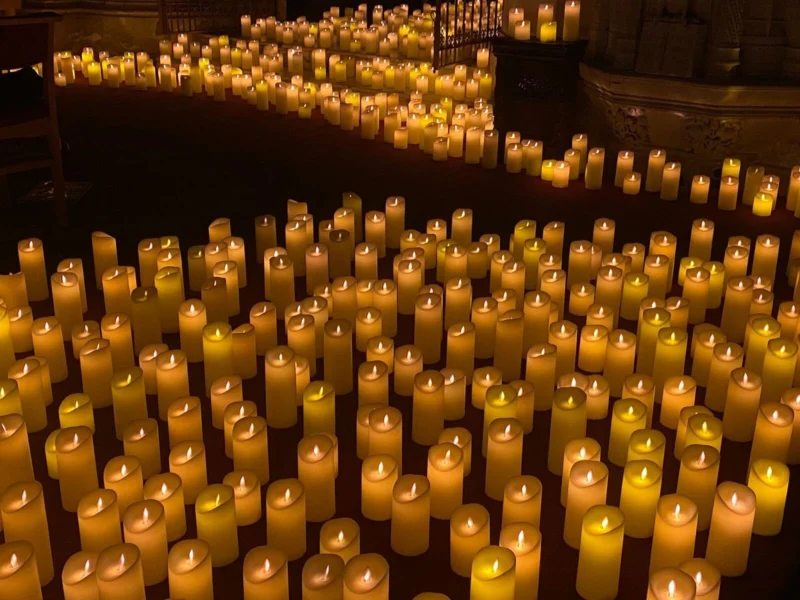
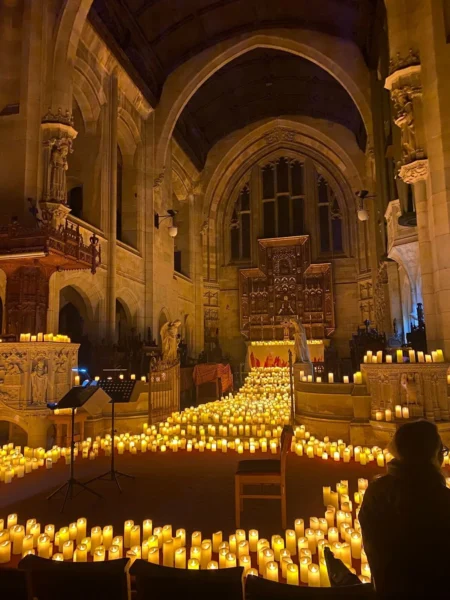
Last Saturday, St David’s Church was transformed by the golden glow of hundreds of candles decorating every surface, from the flagstone floor to the stage. You’ve probably heard of the candlelight concerts that are trending across the UK right now – and what better place to host one than this ornate historical building.
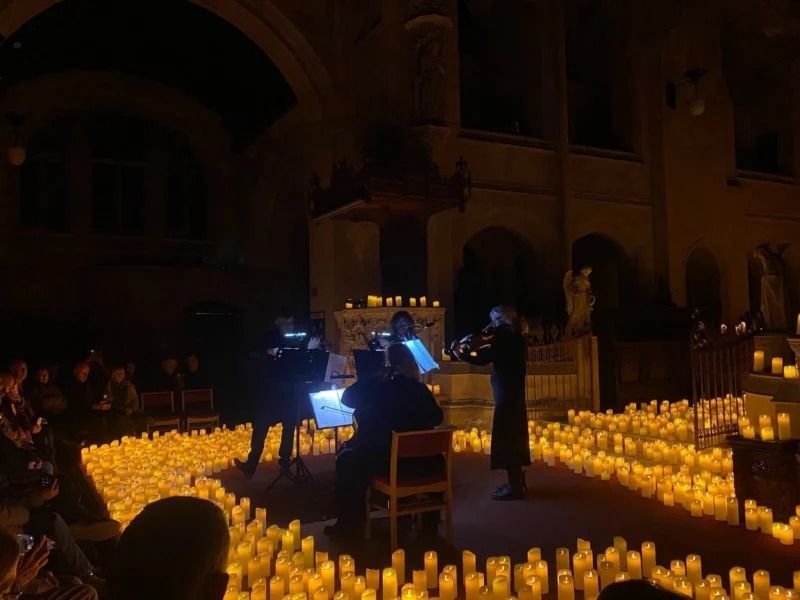
The atmosphere inside felt intimate, and brimmed with magic. Don’t worry about fire hazards, they were LED candles – but it was just as enchanting as if the risk of setting my jeans alight was real. The crowd’s murmurs of anticipation fell silent as four elegant musicians took their places, and soon the church was filled with the enchanting soundtrack of Pirates of the Carribean, unfolding into a captivating medley.
Organised by Fever, these candlelight concerts celebrate public favourites, from ABBA to Ed Sheeran. This particular event showcased the “extraordinarily varied music of Hans Zimmer”, presented by the Ambrosian Strings quartet. From the Top Gun: Maverick (2000) theme (tastefully described as “another collab with someone with a mustache”), to “Discombobulation” from Sherlock Holmes (2007), and “This Land” from Lion King, the unique string quartet arrangements blended cinematic masterpieces with classical musicality. Following the Lion King theme, they also played “Can You Feel the Love Tonight” (Elton John) – a choice that to me felt more about pleasing the crowd than focusing on the musicality of Hans Zimmer – but hey, the crowd are the ones who paid to be there.
Jonathan Storer, the lead violinist and founder of Ambrosian Strings, accurately described Hans Zimmer as a “true innovator”. With the scores of 150 feature films to his name, Hans Zimmer is a cinematic legend, having shaped the landscape of movie soundtracks for over four decades. Jonathan’s descriptions and opinions of Zimmer’s work gave new insight into music we’ve heard so many times before.
John expressed that he could really “see the pictures in [Zimmer’s] music” – and the quartet’s talent brought this to life for the audience too. Their evocative medley from Dune (2021) held us in captivated suspense, with every note – and the spaces in between them – commanding our full attention. The quartet showcased iconic collaborations between director Christopher Nolan and Hans Zimmer with arrangements from The Dark Knight (2008), capturing “the dark brooding hate of Bruce Wayne”, and Inception (2010), artfully shifting to an ethereal, contemplative, spacey tone – the lineup covered everything.
“It’s remarkable how Hans Zimmer creates organic and seamless pieces as if they always existed, and he plucked them out of thin air”. Jonathan’s comments came to life through the brilliant skill of the quartet; each member commanding their instrument with expertise that demonstrated decades of professional training. On the cello, Jane provided a beautifully rich, mellow base to complement John and Emma on violin, and Catherine championing the viola.
However, I feel that the appeal of the show comes largely from the candlelight church setting, the branding, and the choice of popular songs – but not so much the arrangement and passion behind the music itself. ‘Fever presents Candlelight’ does not advertise the quartet themselves, but focuses on the setting and theme (be it ABBA or Queen, or Hans Zimmer) to draw people in, often not revealing the name of the quartet on the ticket page. This change in focus reflects how branding through well-known, popular or trending aspects is more successful than advertising through less widely known musicians – i.e., that ‘Candlelit Hans Zimmer Concert’ sells more quickly to the general public than ‘Talented String Quartet’.
One one hand, the shift to popularising orchestra through modern songs makes classical music accessible to a wider audience, and also provides a mainstream gateway for people to get into orchestra in an age where arts like this are struggling. On the other hand, I feel that something special is lost when the arrangement of the songs is managed not by the artists, but by a larger, external company focused on selling tickets – the importance of the musicians and their own personal style is diminished.
At the end of the performance, John thanked the audience for taking the time to come and see a ‘proper string quartet playing real music on real instruments’, hinting at how important it is to support your local musicians in an age where art is often digitalised, fast-paced and isolated from in-person community. If you want to see what else Ambrosian Strings have to offer, check out what they’re doing over the summer – as John put it: “If you happen to be in the buzzing metropolis of St Mary’s church in Torquay (you should be), we are there”.
