


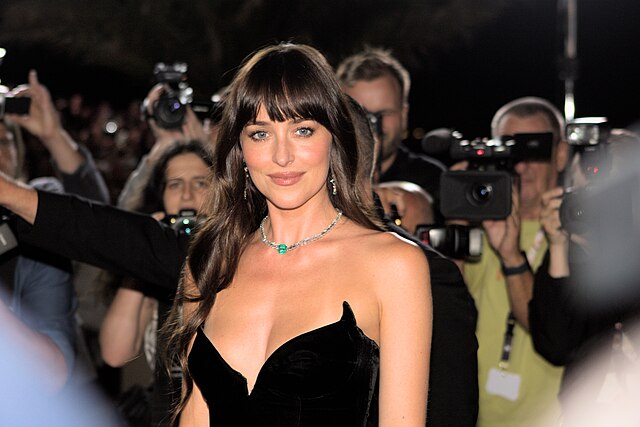
Materialists follows Lucy (Dakota Johnson), an ambitious New York City matchmaker and self-proclaimed “eternal bachelorette.” Voluntarily celibate, Lucy insists she will either die alone or marry someone wealthy. For her, love is less an affair of the heart and more a mathematical equation.
Despite her professional success, Lucy’s own romantic life quickly spirals into complications. At a client’s wedding, she runs into her ex-boyfriend John (Chris Evans), an aspiring actor now working as a waiter. Their chance encounter entangles her in a love triangle with John and Harry (Pedro Pascal), the archetypal “unicorn”, a wealthy, well-connected, tall, and handsome man who appears to embody everything Lucy claims to want.
Director Celine Song, drawing on her own background in matchmaking, crafts a critique of the industry itself. As the film unfolds, Lucy and her colleagues increasingly treat their clients as data points rather than people, culminating in disastrous consequences for one client, Sophie. Through this subplot, the film underscores the dangers of reducing love to a transaction.
The film’s ending has sparked debate. Lucy ultimately chooses John, the man with no prospects, who fails to meet any of her self-imposed standards. Rather than a triumphant return to romance, the choice feels symbolic of Lucy’s lack of self-love, her willingness to settle. Critics have dismissed this resolution as “broke man propaganda,” pointing out that the film offers little evidence of genuine affection between Lucy and John, flashbacks show mainly arguments about money, not moments of tenderness.
Yet Song defends her work, countering: “Capitalism will try and colonise everything, eat love.” The provocation flips the question back on the audience. Are we the real “materialists”, so conditioned by a volatile economic climate that we can only view love through the lens of financial security? Or is Lucy’s compromise a reflection of how messy, illogical, and unsatisfying love often is in reality? Materialists leaves us unsettled, not with a clear answer but with a mirror, forcing us to question whether our scepticism comes from Song’s storytelling, or from our own biases about love, money, and worth.