


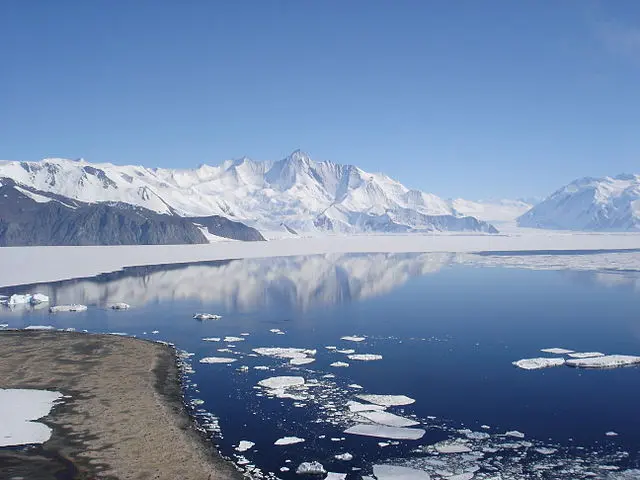
This January, a wave of groundbreaking discoveries on the unique geography of Antarctica has been released, signifying a new era in Antarctic research and climate science. Despite these breakthroughs, certain questions on the nature of the continent’s response to a warming climate are unanswered.
Recent technological developments have enabled scientists to construct a more detailed picture of Antarctica’s surface. Using satellite imaging, researchers have uncovered new evidence on the texture of the terrain, discovering a rough landscape characterised by hills, ridges and major mountain systems.
Though this has provided new clarity on Antarctica’s topography, shedding some light on how the continent’s glaciers will retreat in response to climate change, the rate at which its ice will melt in the future remains largely unknown. A great mystery rests with Antarctica’s ice shelves – floating coastal extensions of the continent’s ice sheet, which serve as its crucial stabilisers and pose a grave threat to global sea level rise.
A great mystery rests with Antarctica’s ice shelves … which serve as its crucial stabilisers and pose a grave threat to global sea level rise.
Dr Ben Galton-Fenzi, a glaciologist at the Australian Antarctic Division has recently led research on the Totten Ice Shelf in East Antarctica. His team discovered that over the last couple of decades, Antarctica’s ice shelves have decreased in mass by around 843 billion tonnes yearly due to melting underneath from warm oceanwater, threatening to destabilise Antarctica’s ice sheet and raise sea levels at an alarming rate. Dr Galton-Fenzi commented on popular concerns, remarking that the ice shelves “will keep losing mass. It is how fast and how much is where the uncertainty is.”
It is also especially tricky to study these ice shelves, as the water beneath them is unreachable by satellites or ships. This data insufficiency perpetuates significant doubts regarding the rate of change of Antarctica’s ice shelves and means the possibility of more extreme impacts on our planet, such as disruptions to ocean currents, cannot be ruled out.
Though cutting-edge technology sparks hope for the preservation of Antarctica and success in combating climate change, uncertainties endure as its ice shelves remain a mysterious threat of sea level rise.
