


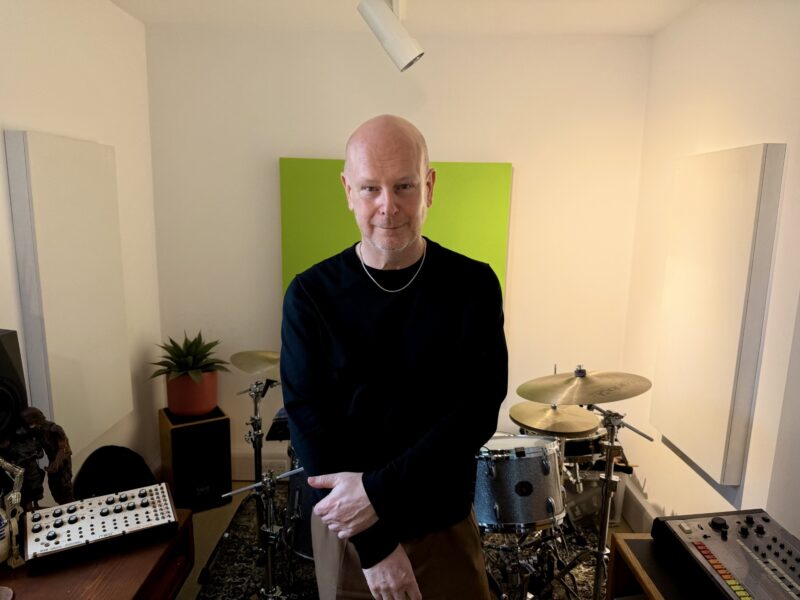
I met Philip Selway at his home studio one morning in April, around four months after the conclusion of Radiohead’s European tour in December. The band reunited last year to play together after a seven-year absence performing a four-show residency in each of five cities across Europe. After attending shows in Berlin and London (reviewed here), I was keen to speak to Philip about the tour, and also his musical career more broadly.
This year commemorates forty years since the band, then known as On a Friday, decided to take the plunge and make music their career path, a time when they were students themselves. Philip recalled playing the Lemon Grove in Exeter 1991, when front man Thom Yorke was in his final year at the university. He described it as a ‘very exciting’ experience, albeit devoid of the glamour of their latest tour as after that gig they ended up in ‘one of the halls of residence, sleeping under a table!’
Those days are far behind them now and their latest tour celebrated a culmination of all the work they have done together. While they have all had time away from the band to work on their individual projects, reuniting has highlighted the importance of their musical relationship. ‘We developed as musicians in the context of each other,’ learning how to play and write, discovering a ‘musical personality, a musical sense of yourself.’
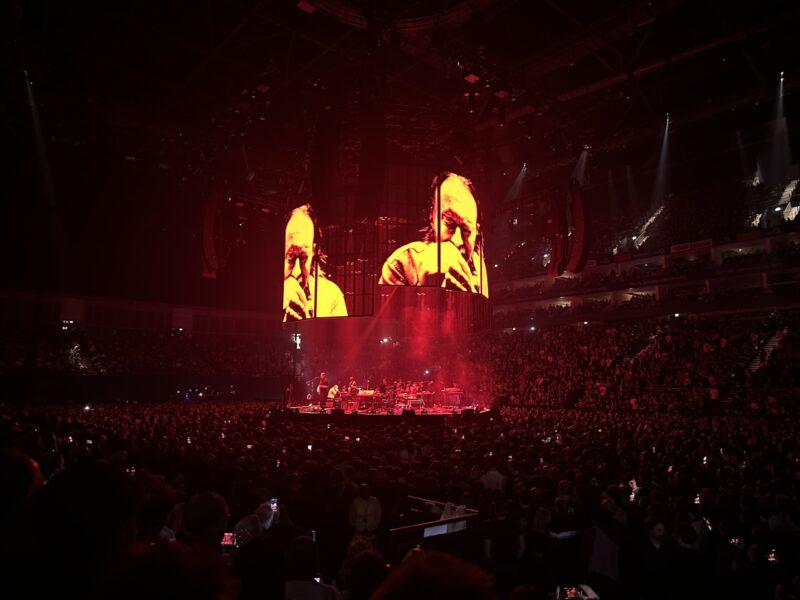
While the tour was not all smooth sailing, for example spending the first half hour of their first show in Madrid barely able to hear one another, the overwhelming feeling was ‘really joyous.’ The staging ‘in the round’ evoked the intimacy of a smaller venue, creating a ‘real connection with everybody that was there,’ as they were able to properly see audience members, including many young people- ‘thank you TikTok!’
These arena shows are a far cry from the more intimate independent venues Philip has played in recent years, performing solo work and with artists such as Lanterns on the Lake. He describes Radiohead’s latest tour as ‘more of a spectacle,’ but insists that independent venues and the people who work in them will always be ‘the heart of the musical community.’ His work with Sybil Bell and Independent Venue Week speaks to the ‘very particular gig-going experience’ of intimate venues, where the symbiotic relationship between an audience who get to be ‘in the middle of it’ and a band or musical artist developing their craft, is established.
Radiohead played their fair share of these venues at the beginning of their careers, before their song “Creep” saw their popularity ‘grow exponentially’. While it was ‘initially so exciting,’ their rapid rise to fame brought with it higher ‘expectations of what you should be as a band… It was a very heady time but I’m not sure I’d go back and do it again to be honest with you. I like where we are now.’
Philip is quick to emphasise the good relationship the band had with the team at Parlaphone, the label that signed them for their first six albums. Yet, their musical evolution was nonetheless influenced by their desire to gradually ‘try to gain more independence and more control’ over the course of Radiohead’s development, the first major milestone of which was the purchase of their own studio after the release of OK Computer in 1997. He also speaks about the creative opportunity of In Rainbows as their first album after the conclusion of their contract with Parlaphone as a ‘statement of what we’d done as a band and where we were at that point.’ It drew on all their experiences making music and touring, marked the beginning of a new era of creative control and ended up feeling ‘like the climax to what we’d been working on for a long time.’
However, being part of a band with such great international success as Radiohead comes with a whole different set of expectations when it comes to creating solo music. Philip speaks about the transformation from supporting vocals in a band, ‘to find that personality and character in your voice.’ There is a sense of vulnerability and being outside of your comfort zone which means ‘inevitably there are moments where you think “what are you doing?” Yet, ‘people don’t actually notice as much as the voice in your head is telling you they will.’
Furthermore, his work with Crowded House’s Neil Finn on the 2009 charity album project The Sun Came out proved immensely valuable to Philip’s development as a solo artist. After putting forward a couple of his own songs, it ‘gave me a real confidence in what I was doing.’ ‘I am in a very fortunate position inasmuch as everybody I get to play with are just amazing musicians,’ and collaborating with them ‘reveals stuff about you musically and opens up a whole other vista of you musically as well and that just keeps on growing.’
Collaboration and connection are themes that clearly runs throughout all veins of Philip’s life as he has also worked closely with Samaritans, a suicide prevention charity he first encountered in Freshers Week at Liverpool Polytechnic in 1986. Working as a listening volunteer for 20 years and latterly as an ambassador, he was drawn to the organisation because ‘all the things that I thought about myself which didn’t quite connect at school; it felt as though I’d landed in a set up where… those things are valued!’ It was also an opportunity for connection both with the people calling and trusting you and with other volunteers: it ‘feels very akin to music in that way because when you’re making music you’re reaching out in that way.’
The creative collaborative spirit is clearly also very strong across the band, with all members having invested their energies into things as varied as other band and solo projects, film scores, dance, photography and olive oil production.
And so, to the burning question we all have on our lips: will Radiohead ever release new music?
‘We’re taking things a step at a time at the moment… I only speak for myself here, but I wouldn’t rule it out.’
I, for one, am firmly resting my hopes on the last part of that sentence.
If you or someone you know is struggling, wellbeing services can be contacted using the email address wellbeing@exeter.ac.uk or call the Samaritans 116 123.
