


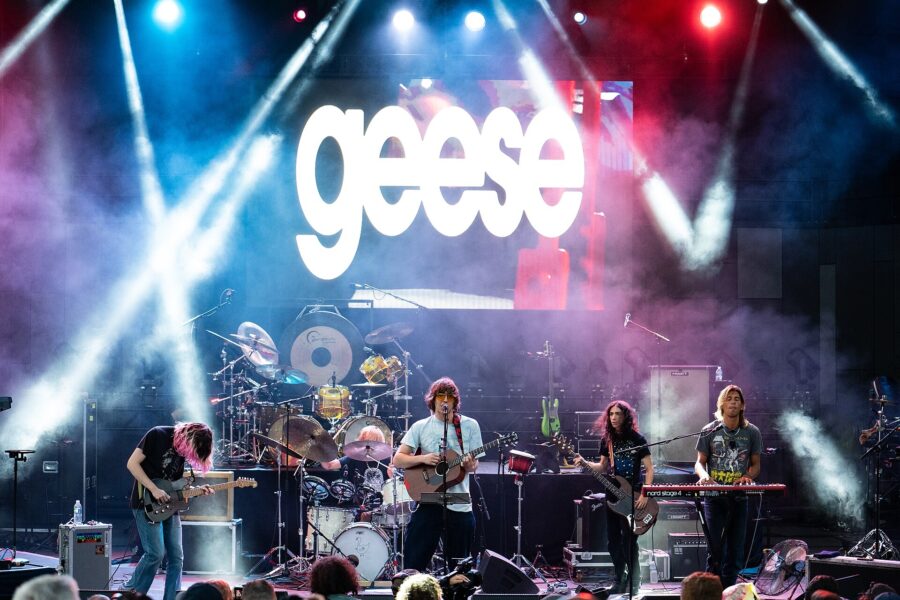
On September 26, American rock band Geese released their third album, Getting Killed. Following post-punk debut Projector and the indulgent classic-rock 3D Country, Getting Killed is a sharply explosive exploration of modern society with Geese at their best.
Geese is composed of Cameron Winter on vocals, keys, and guitar, Emily Green on guitar, Dominic DiGesu on bass, and Max Bassin on drums, as well as touring member Sam Revaz on keys. Winter’s solo debut, Heavy Metal (2024), garnered widespread critical acclaim for the versatility of his vocals and his often obscure yet always insightful lyricism. Getting Killed sees Winter’s lyrics at their most interesting, exploring themes of late-capitalism and its widespread woes; religious and romantic devotion; and confronting a troubling, lonely reality.
Album opener “Trinidad,” the second single, is one of the band’s most polarising tracks. Horns blare and guitars screech over Winter screaming, “There’s a bomb in my car!” The track’s crescendo comes with Winter bemoaning the state of an imaginary family, with dead daughters and a husband burning lead. The second track, “Cobra,” masquerades as a simple love song and might seem a jarring transition, but Green’s cascading riff provides a musical backbone for the rest of the album. “Husbands” is similarly pared down, a rambling mediation on loneliness and being misunderstood.
The title track, “Getting Killed,” is one of Geese’s most interesting songs to date. Winter’s vocals reach the feverish agonies of a manic preacher over a looping sample of a Ukranian choir. The lyrics describe “getting killed by the city,” and the dulling of individual sensation in the city’s chaos, with “I can’t even taste my own tears / They fall into an even sadder bastard’s eyes.” Bassin’s drums ground the furious medley driving the track to its abrupt close before leading into the next track.
I can’t even taste my own tears / They fall into an even sadder bastard’s eyes.
“Islands of Men” breaks in the middle before a gorgeously layered instrumental section, with Winter repeating “You can’t keep running away.” The repetitive lyricism avoids monotony through the variation of the vocals, and how the persistent guitar demands the listener’s attention. Third single “100 Horses” plunges you into a wartime landscape, undercut by tight drums and a galloping bassline reminding you that “There is only dance music in times of war.” “Half Real” is a slower, lyrically sparse track. The sprawling breakdown features Winter’s warbling vocals over a steadily climbing melody commanded by Green’s rapid-fire picking. “Au Pays du Cocaine” is similarly emotive, echoing Winter’s solo material, which the band agreed massively inspired Getting Killed. Tumbling, fluid guitar paired with halting rhythms and yearning lyrics make this the band’s most tender, earnest song yet.
“Bow Down” is a staggering, heavy track about a roadside angelic encounter, culminating in a gritty, punky solo. Bassin dominates this track with rigorous precision, melding with DiGesu’s steady groove to craft a dramatic song caught between the tensions of its rhythms and the fervor of its melodies. It’s followed by “Taxes,” the first single and easily the most popular song off Getting Killed. This sees Geese in more straightforward territory, soaring into a gorgeous crescendo as Winter sings, “I will break my own heart from now on.” “Long Island City Here I Come,” however, is the band at perhaps their most eccentric. Sinister, anxious instrumentals characterized by Winter’s “stompy and weird” piano and howling baritone end up as the ecstatic 6-minute closer. DiGesu’s driving bassline sets up Green’s furious hammering on, all while Bassin feverishly pounds the drums.
The album’s lyrical consistency is meticulous, bringing together abstract poetry with strict sneering at modern life. The composition is similarly gifted, with certain musical motifs returning; “Cobra” and “Au Pays du Cocaine” notably function as a kind of call and response across the album, both in the subject matter of a strained relationship and their similarly flowing chord progressions. Getting Killed is undoubtedly my favourite release of this year. Geese are solidifying themselves as one of our generation’s most talented, creative, and consistent bands; watch out, because here they come.
