


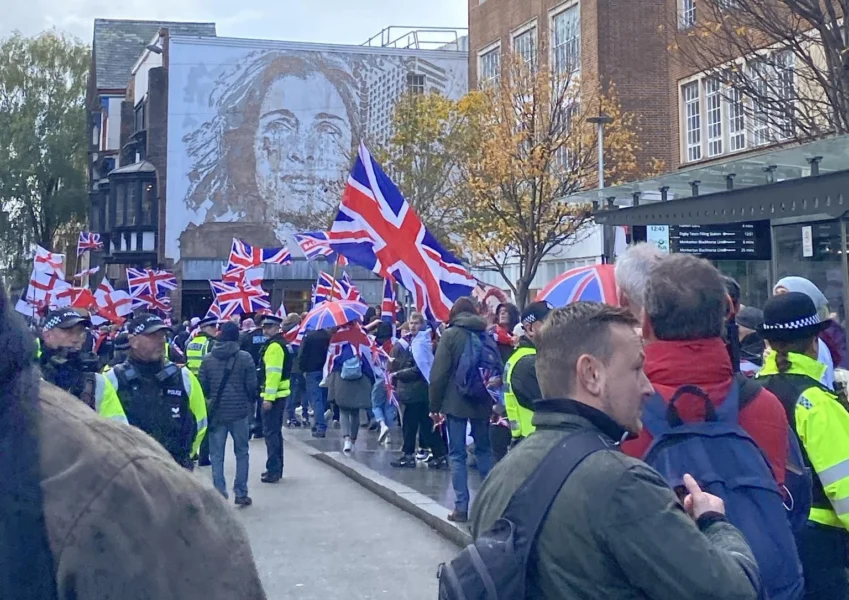
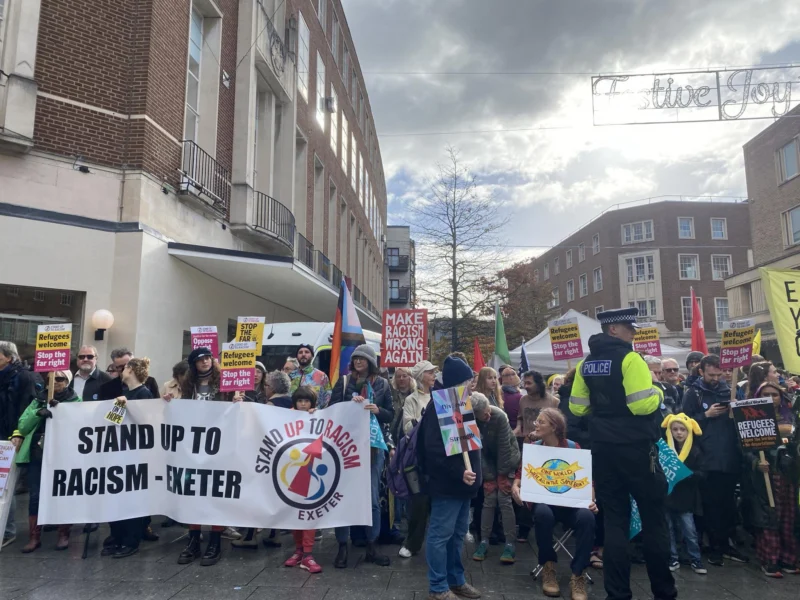
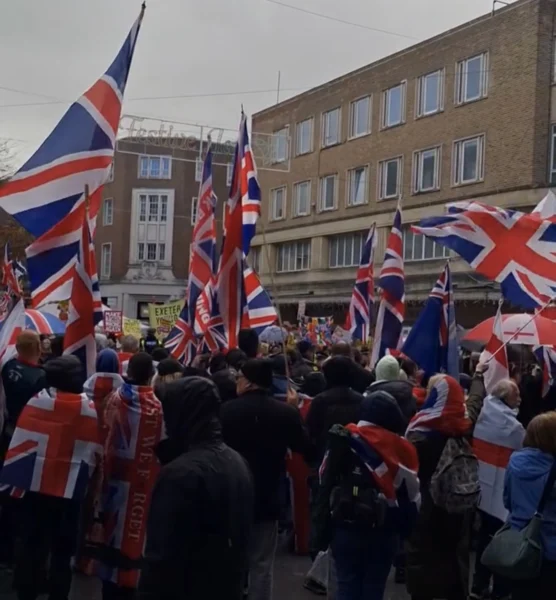
On 25 October 2025, Exeter saw rare high police presence in town to monitor two rival protests which took place in the city. Started from Dix’s Field, around 250 people took part in the British Unity Walk with their Union Jacks held high and headed towards the High Street. Organised by Stand Up to Racism and supported by the Student Guild, approximately 600-800 people joined the Exeter for Everyone counter-protest in Bedford Square to celebrate diversity in Exeter.
Describing itself as “a movement dedicated to the preservation and advancement of the United Kingdom’s values, culture, and heritage”, supporters of British Unity marched with St George’s flags and Union Jacks in tote, along with chants and signs about stopping the boats and opposing digital ID cards.
The Exeter for Everyone protest consisted of 20 organisations and many city councillors, including the Exeter Green Party, University and College Union (UCU), and Exeter City Council Leader Councillor Phil Bialyk who gave a speech at the protest. In their official statement, Stand Up to Racism called on their supporters to attend the “celebration of diversity”. They labelled the British Unity Walk as a “far-right march” and stated that they “reject their politics of hate and division”. They reiterated that “Exeter has a proud history celebrating our city, our wonderful culture, history and diversity … Exeter truly is for everyone.” The counter-protest included signs such as “Refugees welcome” and “No deportations”.
We were unable to get a firsthand account of a student participant of British Unity Walk.
Green Councillor Thomas Richardson of Devon County Council, one of the attendees of the Exeter for Everyone protest, told Exeposé that “there was a strong community atmosphere and people of all ages were there to show that Exeter is a city of sanctuary. I would say that it was a successful protest in response to the British Unity March, there were hundreds more Exeter for Everyone protestors”.
This sentiment was echoed by a student representative of Exeter Labour Society, who told Exeposé that the turnout was “amazing”. They said “We completely dwarfed the far-right march, proving that there’s no room in the city we love for such awful hatred”.
Through a survey, we asked the student body about their experience with the protests, with individual sections especially focusing on international students and students of colour, and received responses from eight students. Exeposé also conducted an interview with a student caught in the midst of the protest. She is a home student of South Asian background, studying Maths and Finance who wishes to remain anonymous.
We asked students about their understanding of the British Unity Walk and what they advocate. Racism and anti-immigration were themes present in all students’ answers, with one responding with “an idea of ‘regaining’ Britain in response to the arrival of asylum seekers and refugees, who they believe are a threat to the British community”, and another saying “racism, division, exclusion”. One student referenced migrant hotels as a point of contention, likely referring to The Hampton by Hilton Hotel near Exeter Airport, which similarly drew opposing protests concerning migration in August. Another student said “I assume supporters of Reform UK attended this march.”
We also asked students about the use of St George’s flags and Union Jacks by far-right movements. One international student noted concern at seeing St George’s Cross spraypainted over street crossings, and another said “they should stop politicising the flag”. The anonymous student Exeposé interviewed said when she sees the St George’s flag she immediately thinks of the far-right – “I don’t want to, I don’t think it should be associated with that. I think it should be something we can be proud of, something that represents our country, but they’ve ruined the meaning of the flag.”
100 percent of respondents had a negative reaction to British Unity’s presence. However, a student acknowledged that everyone has a right to protest if done safely and legally, and that “banning their right to protest is probably not a sustainable solution.” Some of our respondents actually experienced the protest firsthand. This female student had no other route home other than to walk through the British Unity Walk. She faced insults and verbal abuse for wearing a keffiyeh, a Middle Eastern scarf that has become a symbol of Palestinian identity and resistance. She observed attendees chanting “get them off our streets”, intimidating minorities. This student found this especially concerning as they live in an accommodation with primarily international students.
Another student had vulgar and sexist comments shouted at them by men at the protest.
The student we interviewed said she would have made an effort not to be in town at the time of the protest if she had been forewarned – “even if it was for a few hours, I’d rather not go into town for those few hours and just not risk coming into contact with anybody that could be rude to me. Instead, I had to just brave it given that I didn’t have any clue about it.”
Some students avoided leaving their homes entirely during the protest, with one saying “the protest made me scared, my flatmates and friends, who are Muslim and people of colour were scared to leave our accommodation”.
Even those who did not witness the events firsthand expressed fear and concern over the events: “I did not witness it in person, but I felt that it was worrying considering everything else that is going on politically at the moment”. Many other students also discussed British Unity Walk in relation to other far-right movements currently sweeping the UK, with one expressing their sadness over it, saying that like many other UK cities, Exeter’s assets lie in its cultural diversity “through food, shops and its students”.
The protest is being referred to as the first far-right demonstration in Exeter City Centre since 2013. According to our anonymous interviewee, it is likely more will follow – “if one’s popped up in Exeter then why shouldn’t another one pop up? I only feel like the fanbase is projecting upwards.” She also described her experiences as a person of colour as becoming increasingly difficult as of recent – “I just have to watch my back a little bit more now”.
When asked about the rival protests, Reform Councillor Jacqueline Fox of Devon County Council told Exeposé that “this has nothing to do with Reform UK.”
“[T]his has nothing to do with Reform UK.”
While all eight respondents were aware of the protest beforehand, none had been informed by a University channel, instead being told by friends, social media and flyers. One student was not surprised by the counter-protests, noting their awareness of Reform’s recent growth in Exeter. Another student, however, was caught by surprise – finding out while conversing with friends who also happened to be people of colour.
For the anonymous student we interviewed, she had no idea the protests would be taking place, instead finding out by unexpectedly being caught in its midst. She was in town when the march occurred, studying at a cafe on the high street. She had previously seen the Exeter for Everyone group gathered in town, assuming it to be a pro-Palestinian protest. In the cafe, she heard noise outside: “It sounded like there was like a football match going on, and I was like ‘that’s not the Gaza protest’”. She looked outside to see the British Unity Walk carrying signs and English flags, shouting football chants. “At first it was a bit comical, because how is this even happening in today’s society? I respect that they have those views because we live in a society where everyone should be allowed to have their viewpoints. It felt like they were trying to be rowdy and cause a disruption”. She tried to ignore it, which was made difficult by police officers coming upstairs to the cafe six or seven times over the course of an hour.
The Guild published a statement the day before the protest, expressing their support for Exeter for Everyone and said this: “We care deeply about protecting and amplifying the voices of all students”. Their officers were also in attendance. One survey respondent noted finding the Guild’s posting about the event helpful. Despite the Guild’s support, many students expressed wanting more direct support from the University, beyond their desires for the University to be alerting students of these events in advance. The Guild responded that: “We’ll keep building on that approach (to share information about events in advance) so everyone can feel part of these moments of community and solidarity.”
While all eight survey respondents were aware of the march taking place beforehand, none had been made aware through a University channel, with 100 percent of respondents as well as our anonymous interviewee agreeing that the University needs to be doing more to communicate upcoming events like protests, with one student calling it “vital for student safety”. Respondents felt the most effective channels of this communication were emails and newsletters, with one student saying “Emails are checked often and so would reach more people especially if sent in an official capacity by the university”.
Students generally felt the university should be addressing how events like British Unity Walk might disproportionately affect racial minority students and their feelings of safety in Exeter. “They need to do better in catering to students affected by these hateful protests. We feel unsafe and the university did nothing to ease our discomfort”.
They need to do better in catering to students affected by these hateful protests. We feel unsafe and the university did nothing to ease our discomfort.
A University of Exeter spokesperson said: “We work constantly with local policing teams and community partners to keep students safe. Harassment, hate and discrimination goes against all we stand for as a university community, wherever it is experienced. Students and staff should report any incidents they experience or witness to the police or via the new “Support and Report” procedures. They can also reach out to our Wellbeing teams for support.”
According to the anonymous student Exeposé interviewed, “what they’ve got to realise is, from my perspective, the support for these far-right parties is only increasing and so they’ll have to address it at some point or another”.
In the aftermath of the protest, some students reported feeling uneasy and unsafe in Exeter – “it made me feel scared to leave my accommodation over the weekend. Until this day I feel suspicious of everything around me, fearful of being attacked”. Another student said they were unsure if the march would become violent. According to the anonymous student we interviewed, witnessing the march was eye-opening. “When I was in town, seeing everyone in the British Unity Walk made me realise they’re just normal everyday people. It 100 percent makes me more conscious of the fact that I’m going into shops during the day, going for walks – and it’s like ‘what if that person doesn’t support me being in this country?’. It’s scary how it’s almost becoming more normalised. It’s all around me and I can’t differentiate who I should and shouldn’t feel safe around”.
Regarding the Exeter for Everyone protest, the same student said it was reassuring to see people advocating for various issues, like trans rights and pro-Palestine: “it was nice to see people coming together to not let Exeter down”. Other students agreed, with 100 percent of respondents describing having a positive reaction to the presence of Exeter for Everyone. Students of colour also expressed feeling reassured by their presence – “it was such a shame I couldn’t join them because I was too scared to walk to the protest”. Another student described the turnout, which saw an estimated 600-800 attendees, as “incredible”.
For one student, it made them “happy to see people overcome bigotry”. Students also described it as “comforting” and “heartwarming”. One student also noted observing a disproportionately large police presence around Exeter for Everyone – “[it] felt awful because they were just peaceful”.
Jack Dart, a former Devon Councillor and current founder of Reform Watch, told Exeposé that the British Unity Walk does not represent the people of Devon. “These groups move from town to town trying to provoke resentment, but they do not reflect the character of the places they visit.”
Although he no longer lives in the county, Dart served as a councillor in Torquay and spent a great deal of time in Exeter, admitting to knowing the communities there well. He said that “The Devon I know is defined by decency and openness, not hostility. It is a county shaped by hospitality, long used to welcoming people from across Britian and beyond.” When asked about his reaction to the rival protests, he told us that “What [British Unity supporters] lack in numbers, they try to make up for in noise, but the truth is that most people in this country reject the hatred they spread.” However, Dart warned that the people of Devon cannot be complacent. He said that “The rise in organised hatred is real … Communities like Devon, and others across Britain, show a better path when they stand together and say clearly that decency will not be drowned out.”
What [British Unity supporters] lack in numbers, they try to make up for in noise, but the truth is that most people in this country reject the hatred they spread.
Councillor Thomas Richardson agreed with Dart that “the [British] Unity protestors do not speak for the people of Exeter or Devon.”
The Devon and Cornwall Police kept both protest groups from clashing. They told Exeposé that “Prior to the event, officers liaised with protest organisers to ensure people could exercise their right to protest peacefully while minimising the impact on residents and business.” We were informed that no arrests were made at the city centre demonstration.

