


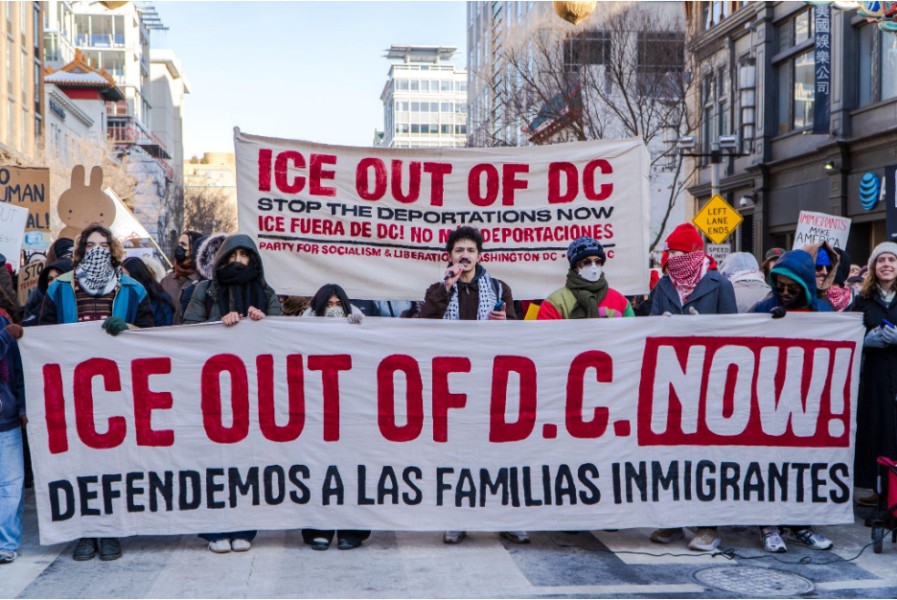
Turning the corner onto 7th and H street, just a few blocks from the White House, you can hear the calls of a growing crowd. Despite the subzero temperatures and permanent ice that has covered DC’s sidewalks, a movement has taken to the streets to make a simple demand: to remove Immigration and Customs Enforcement, ICE, from their communities.
Across all 50 states, individuals have demonstrated in increasing numbers against the Trump administration’s controversial campaign to remove undocumented individuals from the US by increasingly erratic means. Recent actions during its latest swell, Operation Metro Surge, have divided a nation and exposed growing fractures within the GOP. The deployment of thousands of agents, with newfound powers, has led to violent clashes between demonstrators and federal agents and the fatal shooting of two US citizens. Previous consensus within the Republican party appears to be melting under pressure from its handling of the violence.
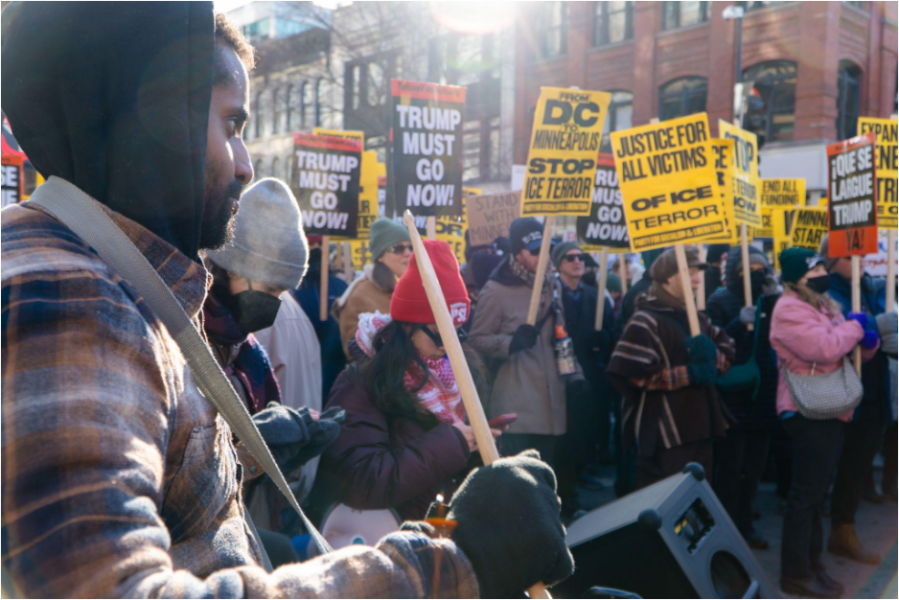
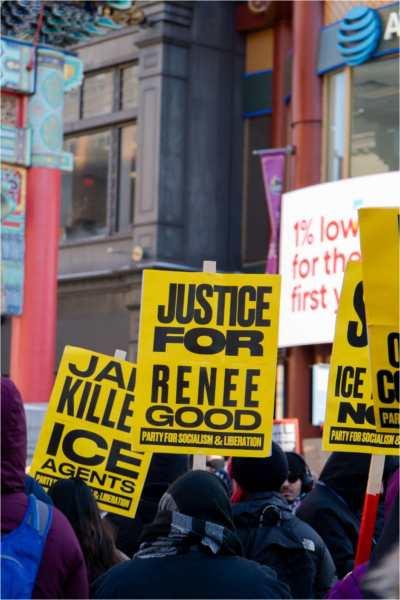
On January 7, Renee Good was shot three times in what has since become a highly political examination of the conduct of ICE in the United States. This being 2026, the footage, captured from multiple angles, was heavily scrutinised by both the press and the public. Public consensus largely contradicted the findings of the Trump administration at the time, that being that Good had used her car as a weapon to hit the officer. Trump blamed Good for her own killing, telling the New York Times “She didn’t try to run him over. She ran him over.” Kristi Noem, head of the Department of Homeland Security, DHS, labeled Good a “domestic terrorist,” without evidence.
The federally controlled FBI was promptly handed the case and state investigators were subsequently removed from the investigation entirely. No investigation will be conducted into the conduct of the officer, nor the legitimacy of their fatal choices. The current investigation has instead opted to investigate Good’s widow, Becca Good. The public’s reaction has been divided, though largely critical.
The Trump Administration drew further public ire for its detention of 5-year-old Liam Ramos. Ramos was not the only one, with at least six children being confirmed to have been arrested from Ramos’ school district during Operation Metro Surge. Whilst Ramos’ story is not unique, the image captured of an outsized Ramos being led into a large, unmarked SUV has become an online flashpoint for critics of the administration. Ramos and his father were both detained and held in an ICE detention facility outside San Antonio, Texas. Just one of many, with plans to grow these substantially in the coming years. Ramos and his father have since been returned to Minnesota by order of a federal judge.
Public outrage has continued to grow across the US in response to the humanitarian crisis being created by ICE. And perhaps no community has been more touched, nor more active in its response to ICE than in Minneapolis, the home of both Good and Ramos. Protestors have become adept at locating vehicles suspected of belonging to ICE, identifying them, following them, and alerting others to the threat. By honking horns, gathering bodies, and blowing whistles, grassroots activists have created a competent and growing response network to frustrate ICE efforts in their neighbourhoods.
As the agitation of activists has increased, so too has the reaction of federal agents. Whilst protesters hurl snowballs and words towards ICE agents, many are met with tear gas, projectiles, and pepper balls leading to lasting physical and mental impacts. On January 24, just two weeks following Good’s shooting, Alex Pretti, a 37-year-old ICU nurse, was one of these protestors. He was then shot ten times whilst attempting to aid a fellow, female protestor. In an attempt to justify the killing, the Trump administration was quick to label Pretti as “a domestic terrorist,” claiming he “attacked” law enforcement. However, as the public poured over the available footage, it became clear that Pretti did not attack any federal officials, nor did he reach for the gun he had on his person.
Kristi Noem stated that his weapon contained, “dozens of rounds of ammunition – wishing to inflict harm on these officers…brandishing like that.” Trump himself appeared to double down, saying, “You can’t walk in with guns. You just can’t.” For supporters of the Second Amendment—the right to bear arms – this was seen as an unjustified encroachment on their civil liberties. Gun rights activists, many of them previously unquestioning supporters of Trump, found these comments to be baseless, with the NRA publicly criticising Trump.
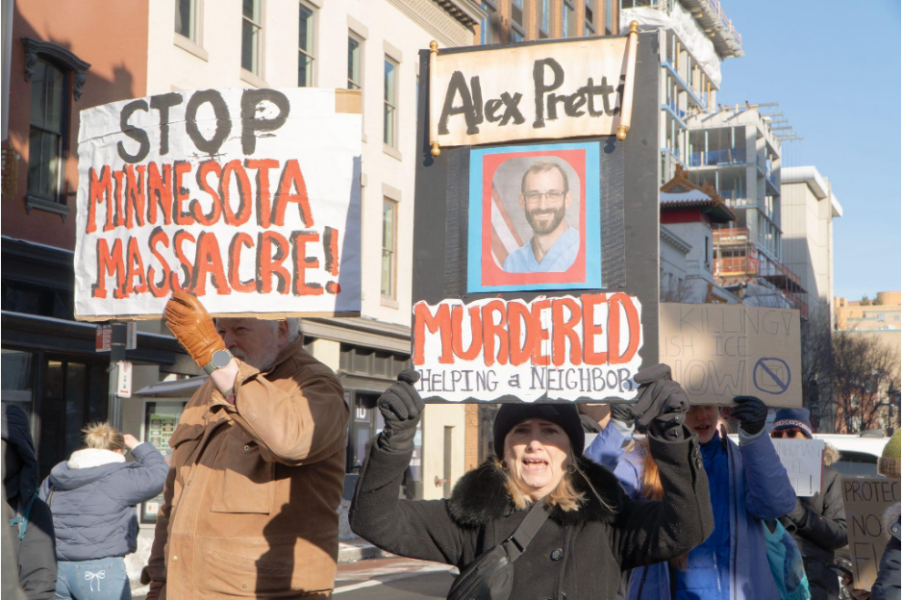
Kyle Rittenhouse, outspoken figure for gun carriers, responded to administration officials by stating “Carry everywhere. It is your right. #ShallNotBeInfringed.” Rittenhouse further criticised Congressman Hakeem Jeffries, minority leader of the US House of Representatives. Jeffries had identified the ideological tension between the handling of Rittenhouse’s case in 2020 and Pretti’s in 2026. In response, Rittenhouse labelled him a gay communist supported by pedophiles and women beaters. Such is the state of politics in 2026.
The case of Kyle Rittenhouse exemplifies the growing tensions for many Republicans. Just a few blocks from the shooting of Renee Good was the murder of George Floyd by local police officer, Derek Chauvin. In response to the murder, violent protests lit up across the US, fueled by anger towards an unjust system of justice. Kyle Rittenhouse, just 17 at the time, became an opposing figure for critics of the protests. Defending a local business, and armed with an AR-15-style rifle, Rittenhouse stalked a route known to be used by the protestors.
Unlike Pretti however, Rittenhouse shot three men, killing two. Rittenhouse had many supporters for his actions at the time, including President Trump, who claimed it was a necessary matter of self defence. Trump later referred to Rittenhouse as a “nice young man,” inviting him to Mar-a-Lago and donating to his acquittal fund. Many figures in the Democratic party have been quick to identify the irony that MAGA has employed to justify their support for Rittenhouse, but not for Pretti.
Another infamous example of the support with which the Second Amendment enjoys within the MAGA base is the brandishing of weapons at BLM, Black Lives Matter, protestors in 2020. During the BLM protests of 2020, Mark and Patricia McCloskey gained notoriety within the GOP for brandishing their firearms at protestors. They were praised for exercising their rights and defending their property, receiving the opportunity to speak to voters during the RNC in the run up to the 2020 US elections.
Proponents of the Second Amendment and those who wish to shrink the federal government have been spooked by this second iteration of the Trump administration. Already facing ballooning fiscal concerns, and eye-watering military budgets, supporters have been aghast at administration officials’ latest claims that guns do not belong at protests. In doing so, a large portion of their base has felt alienated from their President. Worryingly for the administration, support for ICE has sunk among Republicans. Recent polling suggests almost a third of Republican voters believe ICE has acted too aggressively, an increase of 10 points from July 2025.
Among all voters, support for ICE has collapsed with 61% of individuals believing ICE has gone too far, reaching up to 94% within Democrats. And as Republicans lose personal faith in its credibility, so too, does it seem, they are losing their support for the President. 61% of Republicans no longer believe their elected officials in Congress have an obligation to support Trump, up from 55% this time last year, indicating a steady decline in confidence.
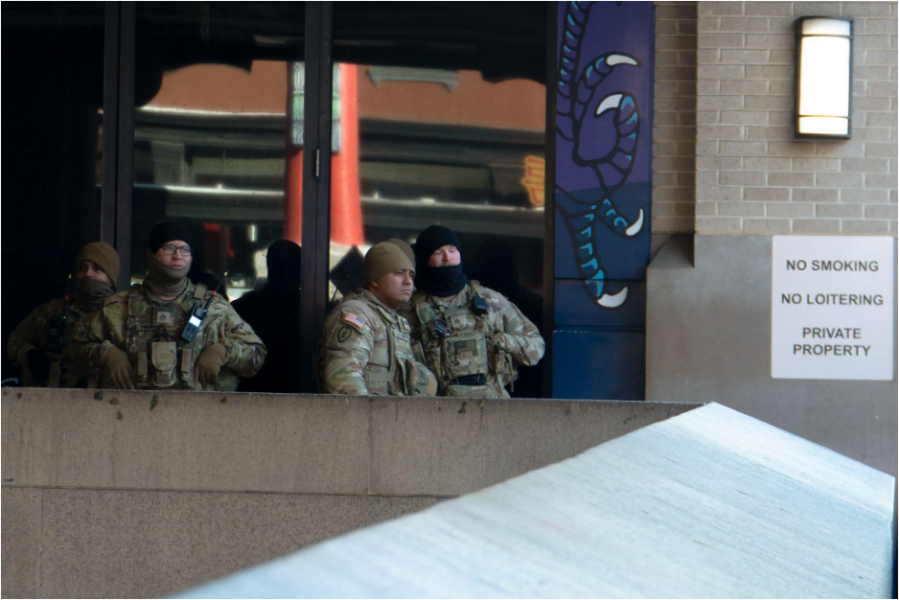
The increased presence of federal troops, military members, national guard, and a breaking down of citizens’ protections from unwarranted searches, has deterred many former supporters of the President. Recently, two Republican Senators, Thom Tillis of North Carolina, and Lisa Murkowski of Alaska, publicly criticised Noem, calling for her resignation in the wake of these shootings. Sen. Ted Cruz has warned that the administration was in danger of losing its credibility and Rep. Thomas Massie of Kentucky has publicly expressed his discontent with the White House.
This recent divide has sent a cold shiver throughout GOP politics, demonstrating Trump’s grasp on power is not as strong as it was one year ago – constant U-turns and reversal of narrative have eroded trust in his leadership. Party consensus among the Republican party has always been a tenuous coalition, remaining poised to distract and divide the party if not handled swiftly by this previously charismatic and capable leader.
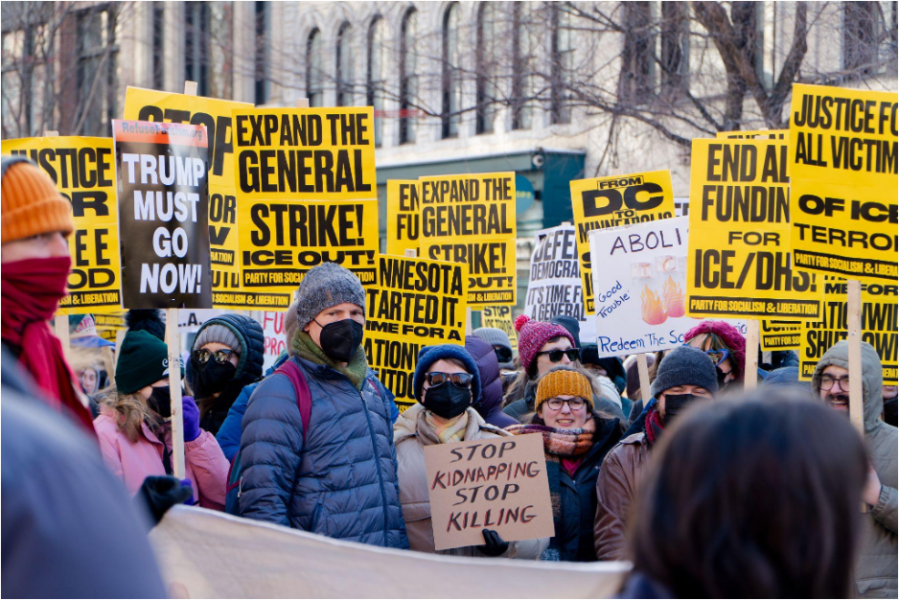
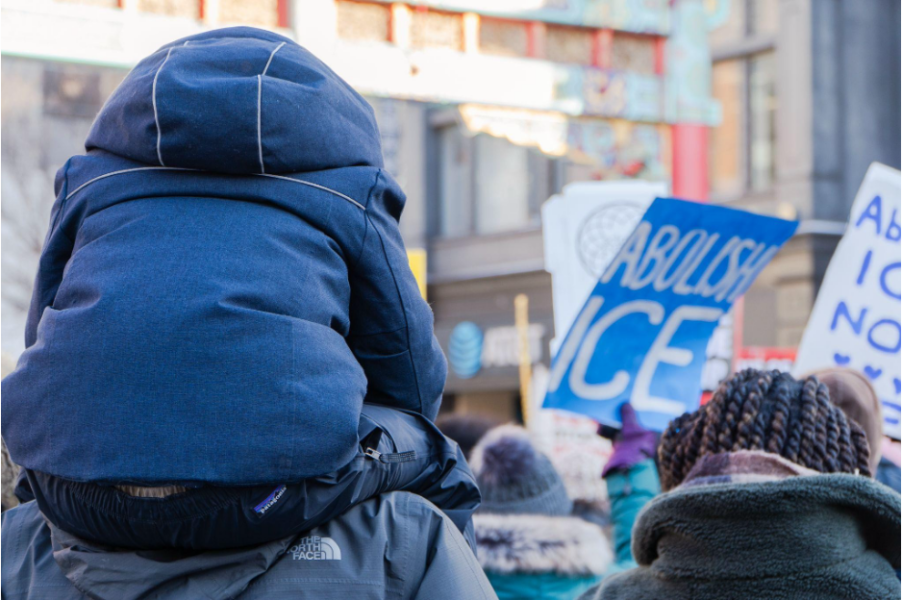
Many protestors arrived with signs and posters made from simple tools at home.
To quell the potential rebellion from within, the Trump administration has sought to distance itself from its initial approach. Rescinding their most blistering attacks on Good’s character, they have described the event as a tragedy.
Another candid indication of a change in tack from the White House is the removal of Gregory Bovino, replaced by border czar Tom Homan. Mr Bovino has led ICE campaigns in Los Angeles, Chicago, Charlotte, New Orleans, and Minneapolis, becoming a divisive figurehead of the department. The demotion of Bovino (he is not out of a job) and removal to California is the clearest signal yet of the fractures these recent crises have sent to the top of American politics.
Whilst changes at the White House have been gradual, for local politicians the blowback has been immediate. GOP candidate, Chris Mandel, for the Minnesota gubernatorial race (to become governor) has dropped out. In his resignation, he cited the inviability of a Republican candidate within the current political climate, stating “United States citizens, particularly those of colour, live in fear…That’s wrong.” This has left the door wide open for the upcoming election this fall, when neither incumbent Walz – himself swamped in scandal – nor opposition Mandel are in the running.
And across the country, Republican officials have become increasingly vocal critics of the administration’s approach. New York Republican Andrew Garbarino, chairman of the House Homeland Security Panel, has requested public testimony from top immigration officials, and Texas Republican Michael McCaul has joined Bill Cassidy of Louisiana to demand full investigations into the killings. Others have signalled they are willing to cooperate with Democrats to draw up new reforms for ICE. Senator Susan Collins of Maine has broken rank with many of her Republican colleagues in seeking to turn down the activity of ICE in her state, further endorsing a new bill for Maine which would require ICE to obtain judicial warrant to enter private locations of schools and health care providers, among others.
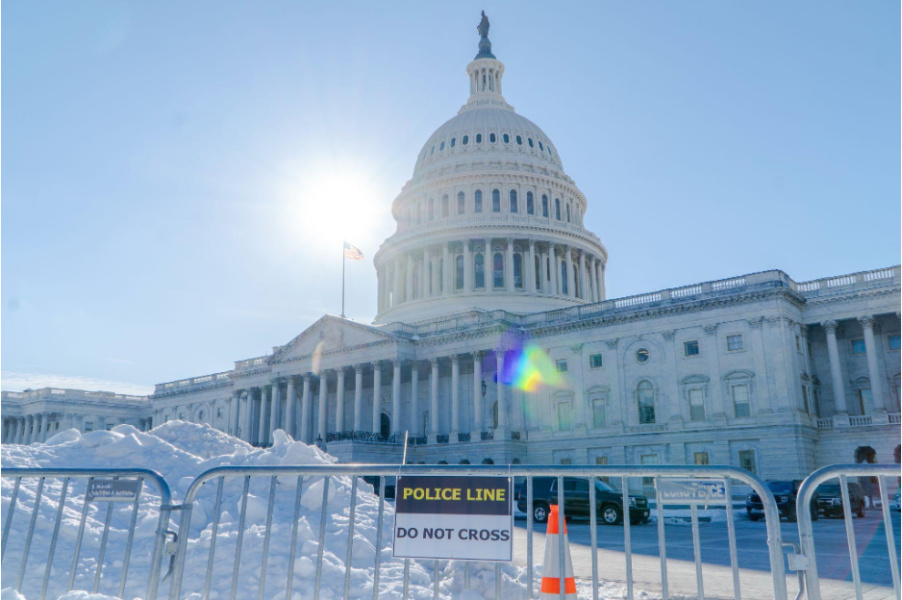
Amid the growing public outrage, news of deals to reform ICE have emerged, suggesting a tempering of the administration’s expectations for the force. As part of any new deal to continue funding the department, Democrats, and some Republicans, will be keen to capitalize on this moment to ensure restrictions are placed on ICE before further federal funding is granted. These would likely come as part of a deal to reopen the government. Unlike the last shutdown, it appears Trump is keen to avoid a repeat of the lapse in federal funds, which remain deeply unpopular. This makes the likelihood of a deal far more realistic, something the President would not and did not concede on during the last record-long shutdown.
This is not the position Trump found himself in just one year ago. Top officials will be wondering how they can maintain their control and ability to set an agenda with upcoming midterms, where it will be crucial the President can prove his capabilities as commander-in-chief.
But grasping the moment, voters will continue to come into the streets as the cold thaws and the political ice begins to crack.
