


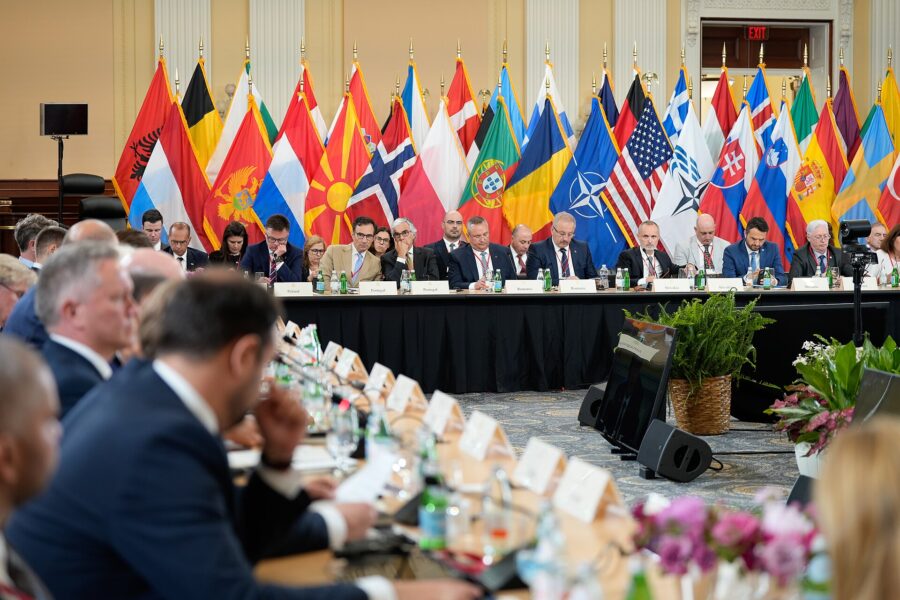
NATO has begun to wane under the weight of the Iran conflict.
On 24 April, Reuters reported an internal Pentagon email that outlined a US plan to punish NATO allies for their perceived passivity, criticising their failure to support its Iran campaign. This email was provided to Reuters by an official on condition of anonymity.
The US has repeatedly criticised NATO for their reluctance to become involved in the war. Specifically, their focus is on the refusal to grant Access, Basing, and Overflight rights, abbreviated ABO. This refers to the permission for US forces to access facilities, base troops and aircraft, and fly through the airspace of allied nations.
In a note, Elbridge Colby, the Pentagon’s top policy advisor, wrote that ABO was “the absolute baseline for NATO”.
European countries, who, unlike the US, are well-within reach of Iran’s long-range missiles, face being punished by the US for their refusal to become involved. For Spain, who have taken a firm “no to war” stance against the US-Israeli action and labelled it illegal and dangerous, the US have discussed suspension from NATO. Responding to this, NATO has said that there is “no provision” to expel members.
For the UK, the US discussed reviewing their stance on British sovereignty over The Falkland Islands. Far-right Argentine President Javier Milei, who is a supporter and admirer of Trump, has in the past stated that the overseas territory, whose islanders voted 99.8% to remain a British territory, ‘will always be Argentine’. When asked about the 24 April report regarding The Falkland Islands, a No 10 spokesman said that the government “could not be clearer about the UK’s position”, and that “sovereignty rests with the UK”.
The UK has allowed the US to use British bases to launch missiles, and the RAF have participated in missions to destroy Iranian drones. Together with a coalition of over 50 countries, including France, Germany, and Italy, the UK has also pledged to keep the Strait of Hormuz open after a lasting ceasefire or the end of the war.
Keir Starmer has insisted that greater involvement is not in the UK’s interest. This is to the apparent surprise of the US who, despite being the only country that Article 5 has ever been invoked to defend, feel that they are not getting enough out of NATO.
This is far from the biggest hit NATO’s stability has taken. In 1966, under de Gaulle, France withdrew from NATO’s integrated military command and expelled NATO headquarters in France. However, the Pentagon email does signal a level of uncertainty, undermining the alliance’s cohesion and credibility.
It also brings into consideration the consequences of a NATO collapse. Most immediately, the fate of the Baltic countries, who border Russia and rely almost entirely on the alliance for their security. Germany has, under the reassurance of the NATO framework, deliberately kept its military weak. Perhaps most alarming is the possibility that countries sheltering under the alliance’s nuclear umbrella may feel compelled to independently pursue nuclear weapons, renewing a global arms race.
