


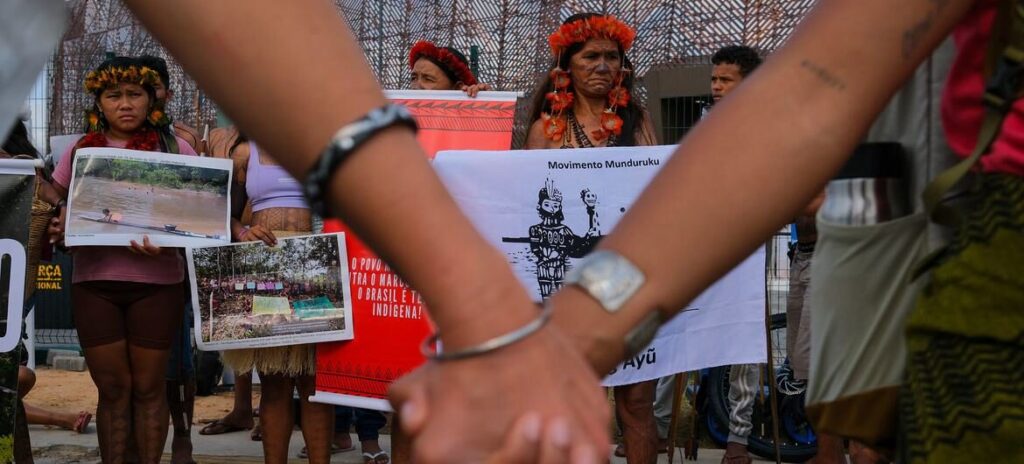
On Friday 14th November, about 90 members of the Munduruku people from the Amazon basin blocked the entrance to COP30 for several hours as part of a peaceful protest. Alongside green activists, they demanded progress on local issues like the protection of indigenous lands and the destruction of the Amazon Rainforest, as well as global climate change initiatives. Protestors intended to gain an audience with Brazil’s President Lula but were denied. Instead, COP President André Corrêa do Lago met with the protestors to discuss their concerns for several hours.
Estimates indicate that the Amazon Rainforest contains 10% of the world’s species and 150-200 billion tons of carbon, meaning that its preservation is of global concern.
While the exact nature of these discussions is unclear, the Munduruku people have a long history of protesting to defend their land from environmental degradation. Munduruku Indigenous Territory is threatened by deforestation and illegal logging but was particularly damaged by illegal mining during the Bolsonaro administration, with a 363% increase in degradation from the practice. With other indigenous groups, Munduruku demonstrators therefore hope to highlight the importance of demarcating indigenous territories for the protection of ancestral locations but also for preventing the exploitation of important natural environments. Estimates indicate that the Amazon Rainforest contains 10% of the world’s species and 150-200 billion tons of carbon, meaning that its preservation is of global concern.
Elected on a platform promising to protect the Amazon Rainforest, President Lula recently launched an initiative to support developing countries in preserving their tropical rainforests. Despite this, Lula’s ambitions to boost economic growth through massive infrastructure projects within four years sometimes appear contradictory to these environmental objectives. Amongst them, a new four-lane highway cutting through miles of the Amazon rainforest to reach the city of Belém, where COP30 is being held, has been criticised for its damage to protected areas of rainforest and disruption to the livelihood of locals.
“We are all together and mobilising. We are in a democratic country where we can take actions. And this feels good”.
Indigenous protestors at COP30 also criticised the recent grant from the Brazilian government allowing oil exploration off the Amazon coast, something Raoni Metuktire, leader of the Kayapó people, deemed “a very bad thing for us” as “these large projects affect … Indigenous people”. The decision to allow oil company Petrobas to drill lies in the hope that it will promote economic growth in the area and support Brazil’s transition to green energy. However, indigenous groups, who say they weren’t consulted about the licence, fear that an oil spill would contaminate the Amazon River, threatening the bird and fish species that dwell there at a massive environmental cost.
With COP30 coming to an end, one important outcome is that these indigenous voices have been heard on the world stage. After Egypt, the UAE, and Armenia, Brazil is the only democratic nation to have hosted the conference for four years and allowed demonstrations by civil society groups. One activist for Indigenous food sovereignty, Luiza Salek, articulated what this freedom of speech meant. “We are all together and mobilising. We are in a democratic country where we can take actions. And this feels good”. Therefore, while President Lula did not receive the Munduruku protestors, there is hope that COP30 has allowed their voices, and those of all indigenous activists, to be heard across the world.