


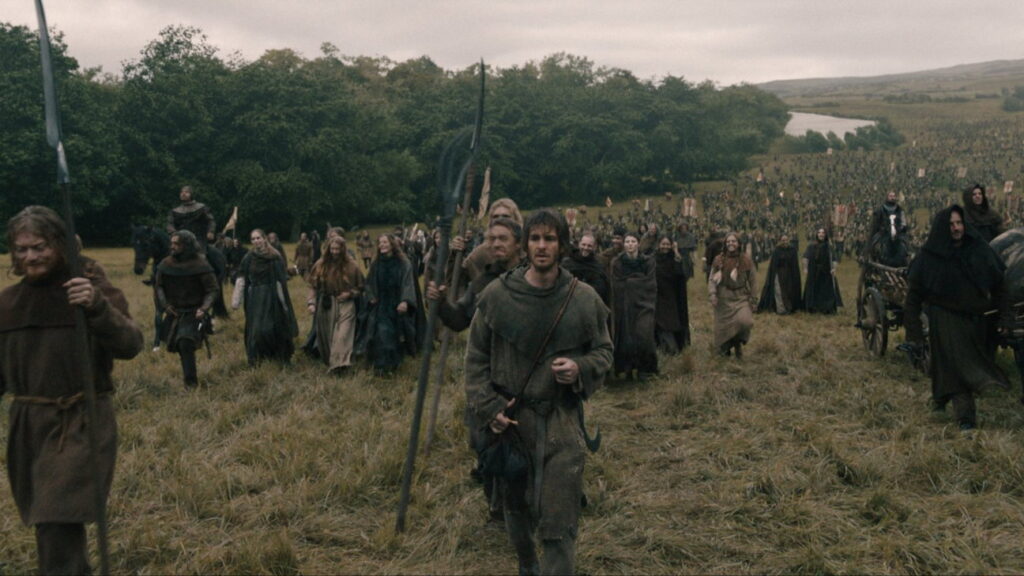
The Uprising, directed by Paul Greengrass, documents a fictional character known as Ploughman, played by Andrew Garfield, who helps to spearhead the Peasants’ Revolt against Richard II.
Filled with bleak, grey imagery, and Greengrass’s iconic shaky handheld camerawork, The Uprising raises many interesting historical and technical questions.
A grungy and historically questionable portrayal of an extremely interesting event
Set in 1381, the story follows three revolutionaries in rural England during the lead-up and execution of the Peasants’ Revolt. Two of these represent the factual leaders of the movement, with the third being Garfield’s fictional character.
However, I – along with many other reviewers – left the screening wondering whether the additional character was necessary.
Garfield’s acting was, of course, extraordinary. With a gripping first 30 minutes, the actor managed to portray the grim and grief-stricken life many led following the Black Death. But this was followed by the character facing many writing faults.
Mainly, our lowly farmer appears to be well-versed in the arts of medieval combat. In multiple scenes, Ploughman pulls off borderline goofy combat sequences. For example, he is seen headbutting a fully armoured knight, then slicing multiple others with his scythe, before coming to the climax of the scene – “Ploughman” stabbing his weapon right into a knight’s nether region. It all seems slightly optimistic from the scriptwriters.
The film also struggles with character depth, with the priority clearly being on conveying the historical situation, rather than complex relationships. This may not come as a surprise to history fans, as the Peasant’s Revolt is widely regarded as one of the “wildest” and most interesting events of British history and should be treated with respect.
Filled with bleak, grey imagery, and Greengrass’s iconic shaky handheld camerawork
But Greengrass ignores that rule too – instead deciding to portray Andrew Garfield’s character as a poor man’s Robin Hood. Seemingly, the character is only added to the plot to introduce a “little-man” for the audience to get behind, which is flipped on its head in the final scene – a portrayal of “Ploughman” as a hooded robber, attacking the King.
Overall, the film is a grungy and historically questionable portrayal of an extremely interesting event but is still worth a watch.
