


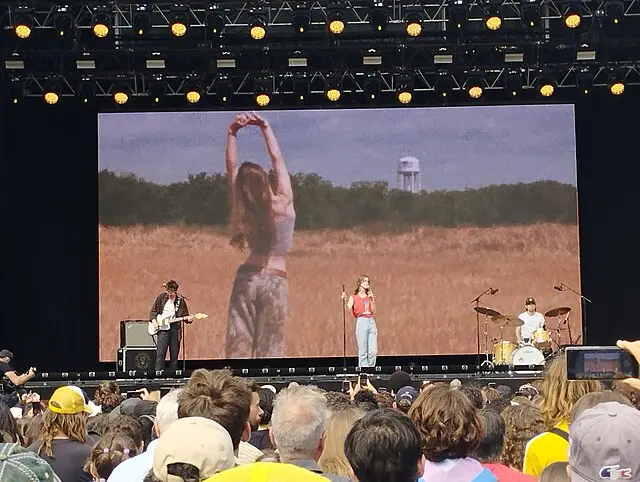
Hayden Silas Anhedönia, better known under the pseudonym of her curated character ‘Ethel Cain’, is an American singer, songwriter, and producer. Hayden has unwaveringly embedded activism for queer communities, marginalised groups, and political causes into her public profile and music, drawing upon her experience as a transgender woman. Her music readily delves into themes of identity and trauma, intertwined with self-discovery, actualisation, and realisation.
She was raised in a religious sphere in the American South’s ‘Bible Belt’ and this is a key theme reflected throughout her discography. These elements are most poignant in her concept album ‘Preachers Daughter’ (2022), exploring themes of female sexuality, rage, and love as a scorned woman through an exploratory narrative of the character Ethel Cain. The album’s second track, ‘American Teenager’, has been widely adopted for discourse on growing up in religious environments in America, and carving your own identity beyond the Church. This has especially resonated with members of the queer community, who have had to navigate the challenges of self-discovery, family acceptance, and broader social acceptance.
The opening chorus lyrics “say what you want and say it like you mean it” have widely been interpreted as a reflection on the passive aggression often felt in the Christian communities of the southern U.S., normalising hiding oneself and being deemed disruptive for self-expression. This is a notion that particularly resonates with many members of the queer community, stemming from the experience of being deemed ‘deviant’ for their identity.
The following lyrics, “I do what I want, crying in the bleachers, and I said it was fun, I don’t need anything from anyone, it’s just not my year, but I’m all good out here” reaffirm this. The ephemeral experience of American high-school culture is juxtaposed with a sense of inner displacement deepened by environmental expectations. A desire for independence and autonomy is expressed, attributes that remain pervasive in the teenage American experience, yet in other tracks, such as ‘Family Tree’, forgiveness from Christ is desired.
This complex relationship with religion, self, and social norms is not an uncommon experience, as voiced by Hayden. In an interview with W magazine, she explained that “it never … was about God. It was more about the way people were interacting with each other in the name of God.” This sentiment can be easily applied to ongoing socio-political discourse in America, with the weaponised interpretation of religious texts being utilised to further marginalise queer communities.
Hayden’s work is powerful and socially moving. Through these themes she has created a safe space for queer communities and those facing the ‘American Teenager’ experience. Hayden and her fanbase are a highly supportive, sociable, and accepting group who are generous with their kindness. This protective space is invaluable for queer communities in the current political climate. I urge anyone that can to engage in queer activism and contribute to these welcoming communities as much as possible.
