


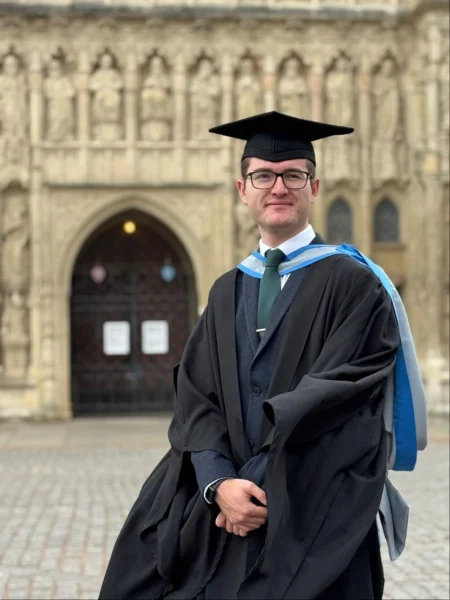
Exactly two weeks after the Devon County Council Elections in May 2025, I sat down with the newly elected Councillor, Thomas Richardson of the Green Party, at the University of Exeter.
Currently a final-year student at Exeter, he is an outlier in more ways than one – not only is he one of the six Councillors on Devon County Council, he is also the youngest on the body by over 20 years. When asked if he ever felt like his age was a disadvantage during the campaign, he told me that he thought the opposite. On a ballot sheet filled with candidates from middle-aged and above, his youth was strength. He prides himself in being the only Councillor who can represent young people.
When Exeposé would approach the Green Party for a comment, it’d always be Thomas Richardson who shows up.
Three years ago, when he first joined the University, it had a dormant Exeter Green Party Society. As someone with a longstanding, if quiet, interest in politics, Richardson took it upon himself to revive it, stem by stem. He swiftly got a Green Party membership and resuscitated the university’s Green Party Society with him at the helm as President. Some time later, he was elected as Exeter’s Young Greens Officer, which saw him help James Banyard of St David’s ward retain the seat for the Greens last summer in 2024. While Exeter’s young Labour and Conservative members have traditionally been part of student political debates, Richardson offered a new perspective at the debate panel. When Exeposé would approach the Green Party for a comment, it’d always be Thomas Richardson who shows up. In both roles, Richardson’s presence offered a distinct grassroots voice which was certainly a breath of fresh air.
This year’s local elections saw Reform UK surge to power all across the country. They are the second largest party in the County, with 18 seats, just behind the Liberal Democrats with 27 seats. I asked Richardson of his impression of the elected Reform Councillors and got a surprisingly optimistic answer. He described them as “hard workers” and said they were “an interesting group with different personalities.” One of the Reform Councillors even praised Richardson for putting himself forward, unified by the sentiment that people want more young people in politics. When we spoke in May, Richardson was frank about his hesitation to pronounce judgement upon his colleagues so soon. He admitted that it was too early to tell before getting a decision on administration duties, but he was curious about Nigel Farage’s influence on the party.
My chats with student leftists tell me that most find themselves drawn to Labour over the Greens due to the left-wing party’s size and influence. I was curious as to how the Greens won Richardson over so early on. He revealed that he did consider joining Labour at first, but he became disillusioned with their politics during the COVID pandemic, particularly because of how environmental policies are often swept aside by Labour. For Richardson, the Green Party does not impress its politics from the top on down like Labour, allowing more autonomy for local politicians to build policies for locals, or as the Councillor says, “local people for local issues”.
On top of thinking that Labour has “lost their way,” he regards the Liberal Democrats as more left-wing than Starmer’s party and lays the blame for Reform’s rise at Labour’s feet.
Our interview occurred just two days after PM Keir Starmer described Britain as an “island of strangers” in a speech about immigration, a break from Labour’s more multicultural image crafted by Blair and Brown. I wondered if Richardson had any grievances on Labour’s representation of the Left. Turns out, the word “grievances” was an understatement. On top of thinking that Labour has “lost their way,” he regards the Liberal Democrats as more left-wing than Starmer’s party and lays the blame for Reform’s rise at Labour’s feet. In the process of chasing votes and “pandering too much to the right, Labour forgot their foundation.” To him, the Farage-led party was only able to rise to the big leagues because of Labour’s refusal to provide real change, forcing people to turn to alternatives.
Richardson had nothing but nice things to say about his experience on the campaign trail. Within the Green Party, he got great advice from the national party, and the local party was very supportive in fundraising. But what gave him a “real good feeling” about campaigning was the weekly increases in Green Party memberships in Exeter which “increased his legitimacy for ambition.” His favourite campaigning memory includes a cat, lots of volunteers, and Deputy Leader of the Green Party, Zack Polanski, who came down to join Richardson on a canvassing Sunday.
With the Greens’ leadership election coming up on 1 August, I tried to gauge whether the Councillor would give his vote to Zack Polanski, or Adrian Ramsay and Ellie Chowns. At the time of our interview in May, he had a strong preference for Polanski. The Deputy Leader thoroughly impressed Richardson as an amazing speaker when he came down to Exeter. He thought that one of the reasons why people no longer see the Green Party as a single issue party was because of Polanski’s strong media presence, such as commenting on economic policy and the NHS, which translates well into the media. Richardson praised Ramsay as a fantastic MP who demonstrated that the Greens can win in lots of places, but the Greens will need a strong leader to counter Farage in the coming years, and Zack Polanski is the man for the job.
Aside from the environment, education policy is top of the list on the Councillor’s agenda for Devon. This is partly because of his experience from an academy system, in which he witnessed the senior leadership pocketing pay rises while the institution struggled to renew glue sticks for students. Above all, what drives Richardson’s work is the desire to make sure communities are not left behind.
Thomas Richardson arrived at the University of Exeter hoping to “bleed green” only to discover he had to plant the seeds of the Green Party into the university himself. Now graduating as a Councillor on top of an International Relations degree, it’s clear that his efforts have blossomed.
