


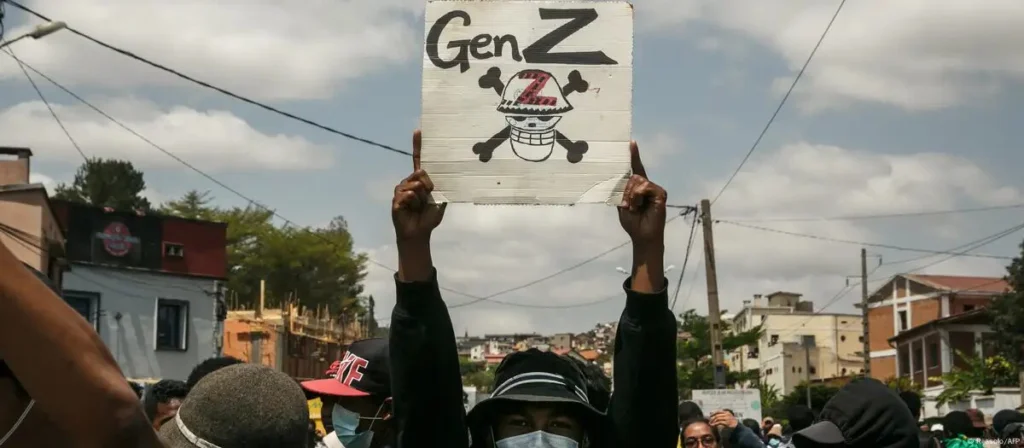
Anti-government protests in Madagascar, led by ‘Gen Z’ demonstrators, erupted in the last fortnight, sparking a violent police response. As a result, 22 people are dead and more than a hundred are injured, according to the United Nations. The president has dissolved his government, but protestors say they will continue until he resigns. What began on 25th September as peaceful protests over failures in the supply of water and power, has become a government crisis for the island nation.
Protestors rejected the dissolution of his government as insufficient, demanding his resignation as president.
Madagascar, located in the Indian Ocean off the east coast of continental Africa, is one of the poorest countries in the world. With 75% of its 32 million people living in poverty, the United Nations described it as one of the “least developed African countries.” Only a third of the population has electricity access, something protesters blame on corruption within the state-owned utility company Jirama.
The country is considered ‘partly free’, and sits between Mexico and Armenia as a ‘hybrid regime’ on the Economist’s Democracy Index. Recent elections have been flawed, with low voter turnout and significant boycotting by opposition parties. Since its independence from France in 1960, Madagascar’s governments have been characterised by instability, coups, and being overturned by protests.
The current president, 51-year-old Andry Rajoelina, came to power following a coup in 2009. Despite conceding he understood “the difficulties caused by power cuts and water supply problems,” and dissolving his government, Rajoelina has criticised the protestors and questioned their motives. Protestors rejected the dissolution of his government as insufficient, demanding his resignation as president.
Madagascar joins Nepal and Indonesia in seeing its government face significant protests led by young people. The Nepalese government was ousted in September by Gen Z demonstrators calling for an end to corruption, bad governance and inequality. Young people also led major demonstrations in Indonesia in August and September, though the Indonesian government withstood them.
