


The University of Exeter’s Streatham Campus has recently been awarded Botanical Garden status, recognising its extraordinary plant heritage and centuries-old connection to Britain’s history of botanical exploration.
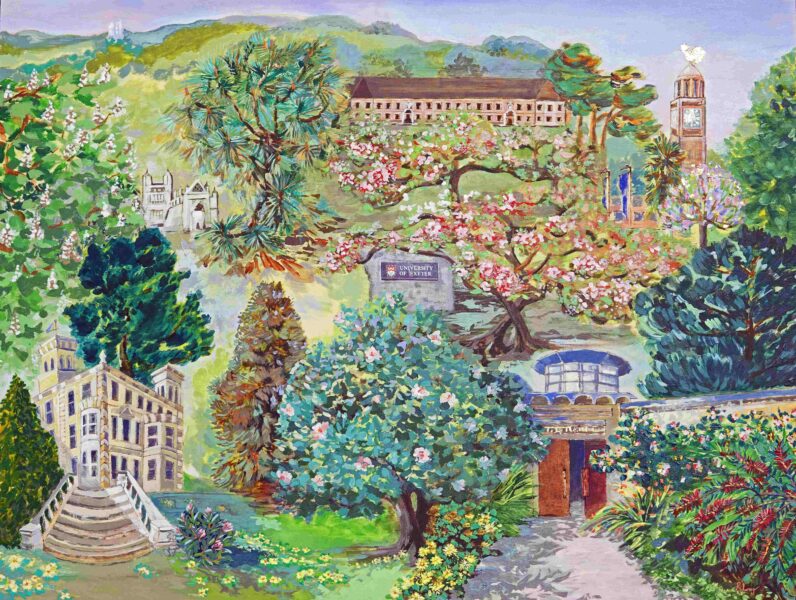
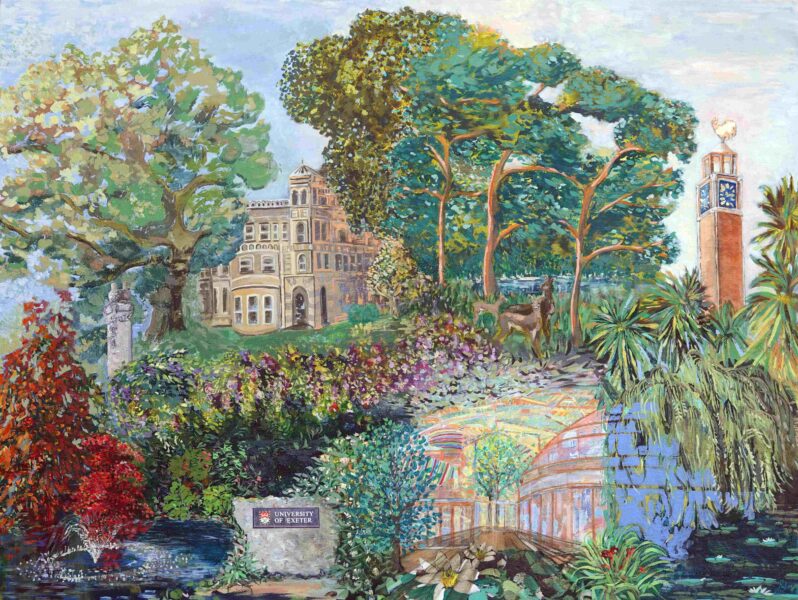
Artist Rebecca Lockyear is shining a light on this hidden treasure through her latest series of paintings, which celebrate the University’s rare and historic trees. Her work captures not only the natural beauty of the campus but also its remarkable place in horticultural history.
“I was amazed to discover that Exeter had such an incredible collection of trees,” Rebecca said. “There are 120 champion trees on campus — 13 of them are the best of their kind in the entire country. It’s a world-class collection that most people walk past without realising its importance.”
Rebecca’s interest in Exeter’s trees grew from her fascination with nearby Sidmouth’s civic arboretum — the first of its kind in the UK. This led her to explore the University grounds, where she was guided by Alex Adams, Chief Arborist for the Grounds Team.
What she discovered was a landscape shaped by Victorian plant collectors and pioneering horticulturalists, particularly the Veitch family of nurserymen. The Veitch brothers, who had nurseries in Exeter and Chelsea, were among the most influential botanists of their era. They helped establish the Royal Horticultural Society and the Chelsea Flower Show, and used Exeter’s mild climate and access to the docks to import plants from around the world.
Because of this connection, the campus became home to a wealth of exotic specimens — some of which are now among the oldest and rarest in the UK. “The Victorians were obsessed with statement trees,” Rebecca explained. “They imported species from America, Asia and beyond, experimenting with hybrids that changed the way Britain looked.”
One such example is the Lucombe Oak, found near Reed Pond, a hybrid of cork oak and turkey oak first created accidentally by Exeter nurseryman William Lucombe in the 1760s. The tree was prized for its evergreen leaves, a rarity among oaks at the time.
“Students pass by that tree every day without knowing it’s one of the originals discovered by Lucombe himself,” Rebecca said. “It’s part of Exeter’s living heritage.”
The Hidden History Beneath Reed Hall
Reed Hall, one of the most picturesque spots on campus, also hides stories of Victorian ambition. Its Italianate Gardens once contained one of Britain’s largest heated glasshouses, built by the Veitch brothers in the 1860s. The only surviving remnant today is the Pineapple Chimney, a decorative brick and stone structure that once powered the glasshouse’s heating system.
“The man who built Reed Hall spent as much on the gardens as he did on the house itself,” Rebecca noted. “He wanted plants from every continent — it was a symbol of prestige and global connection.”
The campus’s diverse plantings also include two national collections — of Azara and Dierama species — along with remarkable specimens like the Swamp Cypress, a tree native to Florida that transforms into brilliant shades of red each autumn.
Art Inspired by the Landscape
Rebecca’s paintings — Journey Through Trees and Forest Bathing — are inspired by the campus’s rich botanical story and the sense of peace found among its greenery. Though artistic in style, each piece draws directly from Exeter’s real trees, landscapes, and history.
As part of the project, Rebecca has developed interactive Google Maps guides, accessible via attached QR codes (at the bottom of this page), allowing visitors to trace the routes and locations featured in her paintings. Each painting has its own map marked with tree icons — click one, and you’ll see the exact location on campus, complete with embedded photos and details about the species. The central red icon reveals the painting itself with all the key points labelled.
“It’s a lovely way to explore the campus,” Rebecca said. “You can walk with a friend — one person uses the map, the other looks at the painting — and together you can discover the real trees that inspired the work.”
Supporting the Future of the Arboretum
Rebecca’s archival-quality prints are available through her website, www.summitpaintings.com. Each unframed print is £90 and designed to fit a standard A2 frame. A special graduation edition, with a wide border for friends to sign their messages, is also now available — a fitting memento for those graduating from such a remarkable setting.
20% of all sales will go to the University’s ‘Gifts to the Estate’ fund, which supports succession planting to protect and renew the arboretum for future generations.
“The campus trees tell a story that stretches back hundreds of years,” Rebecca reflected. “Through my paintings, I hope people begin to see that Exeter isn’t just a beautiful university — it’s a living museum of botanical history.