


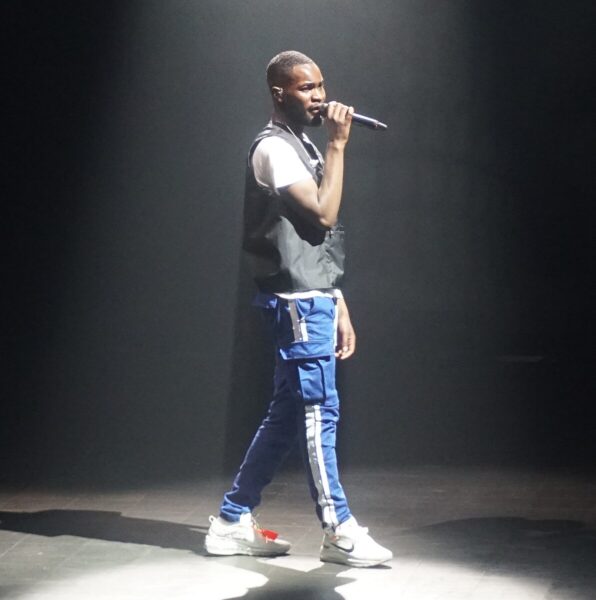
The Boy Who Played the Harp is the long-awaited 4th studio album from legendary grime artist Dave. The album follows the 2021 record We’re All Alone In This Together, a seismic release in the UK rap scene which brought us such pillars of the genre as “Verdansk”, “Clash” (feat. Stormzy), “System” (feat. WizKid), and “Lazarus” (feat. Boj). In the four years of silence from Dave, fans have been eagerly anticipating the return of one of London’s leading cultural voices.
The album opens with “History” (feat. James Blake), featuring gorgeous organ-esque backing keys which introduce the religious themes of the album and a chipmunked refrain by Blake, who sings “You know it’s history in the making.” The opener conveys a historicised tone, with Dave temporally blending the classical and the contemporary, drawing intricate poetic lines of dialogue between the biblical David and the present-day Dave.
The track “No Weapons” (feat. Jim Legxacy) is a strong contender for the best of the album. Newcomer to the UK rap scene, Jim Legxacy (known for his stellar release Black British Music earlier this year), proves once again he is more than capable of standing comfortably among the titans of the industry. Much like their previous collaboration on the track “3x” on BBM, Jim and Dave have seamless chemistry on “No Weapons.” Jim’s melodic hooks balance perfectly against Dave’s sharp and bouncy flows. The production supporting both offers a gripping beat with deep bass and complex drums which builds beautifully into a wave of keys and synths as the song closes.
Dave temporally blends the classical and the contemporary, drawing intricate poetic lines of dialogue between the biblical David and the present-day Dave.
“Chapter 16” is a stripped back dialectic meditation between Dave and the featured grime icon Kano. Bright piano melodies and tight drums accompany a conversational back and forth of verses that more closely resembles a duet of spoken word poetry than a song. Throughout the track small details of production surface, such as short vocal melodies which accent the 6-and-a-half-minute track and keep the relaxing, rhythmic interplay engaging.
“Fairchild” is one of the most dramatic statements on the album, demonstrating Dave’s aptitude for sharp cultural commentary. He foregrounds the voice of Nicole Blakk, who speaks on the female experience of sexual violence and the threat of men in spaces such as clubs or walking alone at night. Blakk powerfully attacks these issues head-on: “Everyone’s a f*****g good guy and they’re makin’ it known, but I’m just makin’ it known that if you ain’t a girl, I guess you don’t know the feeling […] a five-minute walk home feeling like five miles.” In perhaps the most cutting lyricism on the album, Dave also states, “Danger doesn’t look like no killer in a mask, it looks like that kid in the group chat that jokes about – and he won’t ever stop because there’s no-one to correct him, and he might even do it ’cause the system would protect him.”
“Danger doesn’t look like no killer in a mask, it looks like that kid in the group chat that jokes about— And he won’t ever stop because there’s no-one to correct him, and he might even do it ’cause the system would protect him.”
The finale and title track sums up the themes of the album, with Dave asking himself “what would I do in the next generation?” contemplating what he would do for world issues and crises if born in different eras. He navigates through WW2, black liberation movements in the 1960s, and even the Titanic disaster in 1912. He writes: “Afraid to speak ’cause I don’t wanna risk it my occupation, we got kids under occupation […] I talk ‘bout the money in all my accounts, so why don’t I speak on the West Bank?” expressing his guilt for not publicly condemning the genocide in Palestine sooner. Dave closes out the album with an exploration of an array of political issues in a dense and thoughtful barrage of questions.
It seems as the album comes to an end that Dave is offering us food for thought rather than definitive answers. With the range of issues facing the world in 2025, he doesn’t try to offer solutions but rather frames his thoughts through a conversation with his ancestors. In the closing lines of the album we come to the conclusion that progress isn’t a set of easy solutions but “a whole generation of people gradually makin’ change, there ain’t a greater task.”