


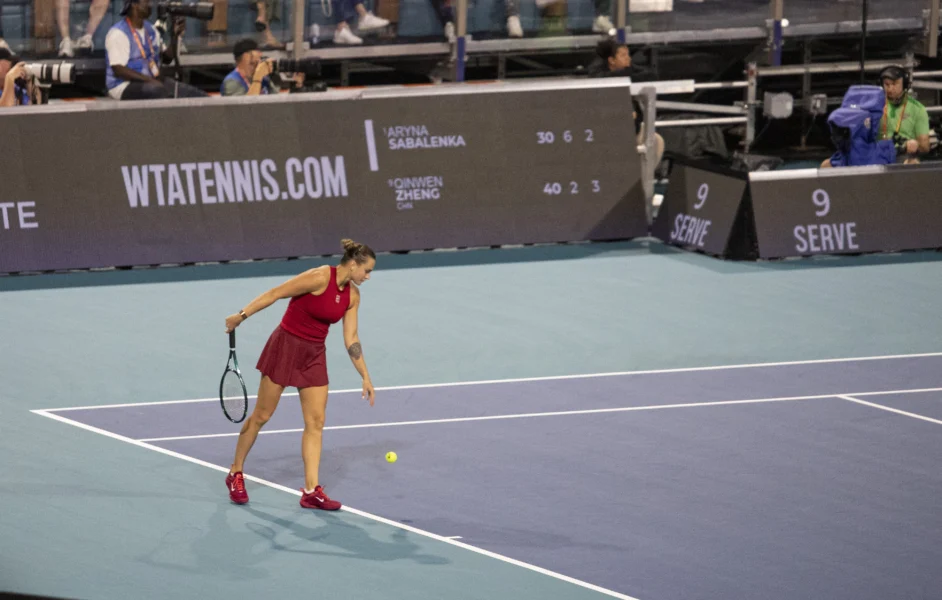
The much-publicised “Battle of the Sexes” exhibition between women’s world number one Aryna Sabalenka and former men’s star Nick Kyrgios ultimately left observers questioning what it truly achieved. Played in Dubai and won 6-3 6-3 by Kyrgios, the match generated headlines but fell short of the spectacle, meaning, and impact promised in its build-up.
From the outset, the exhibition divided opinion. For Kyrgios, ranked 671 and attempting to return from a career-threatening wrist injury, the match offered relevance, preparation for a hoped-for ATP comeback in 2026, and a chance to reshape his public image. For Sabalenka, coming off a dominant season that included four titles and the US Open, critics questioned why she would risk her standing by playing a novelty match against a man whose career has been in decline. Her team argued it would raise her profile further, attract new audiences to women’s tennis, and deliver a lucrative payday. On court however, the contest lacked intensity.
Despite modifications designed to level the playing field, including reducing Sabalenka’s receiving court by 9% and allowing only one serve each, the match felt like a low-stakes off-season exhibition. Former British number one Annabel Croft said it failed to showcase Sabalenka’s true level, although she noted the Belarusian did not embarrass herself. Sabalenka produced moments of brilliance, hitting powerful winners and showing flashes of her competitive fire. Yet her playful demeanour, including stopping mid-match to dance the Macarena during a timeout, underlined that this was entertainment rather than serious competition. Sabalenka insisted the event was positive, arguing it brought attention to tennis and demonstrated her ability to compete credibly against a male opponent.
Off court, criticism lingered over [Kyrgios’] past behaviour, including an admitted assault of an ex-girlfriend and misogynistic remarks
Kyrgios, meanwhile, played within himself, conserving energy and shortening points. Though visibly unfit at times, he appeared capable of raising his level when required. Off court, criticism lingered over his past behaviour, including an admitted assault of an ex-girlfriend and misogynistic remarks.
The event was widely viewed as a public relations opportunity for him to present a more “mature” persona ahead of his planned return. Despite being branded a modern “Battle of the Sexes,” the match bore little resemblance to Billie Jean King’s iconic 1973 victory over Bobby Riggs, which symbolised a genuine fight for gender equality. Instead, it was closer to modern “sport-ainment” – a spectacle designed to attract casual fans, blur competitive boundaries, and generate profit. Although the organisers claimed the match would bring new eyes to tennis, the atmosphere inside Dubai’s Coca-Cola Arena was often flat, and the promised glamour largely failed to materialise. Even as Kyrgios closed in on victory, cameras captured a child asleep in the crowd, an image that came to symbolise the event’s muted impact. In the end, while Sabalenka and Kyrgios both defended the exhibition and will profit from it, the match achieved little beyond stirring debate about the future of novelty events in tennis.
