
On September 4th, the UN General Assembly voted 164 to 1, with six abstentions, to promote a new standard world map that shows Africa closer to its actual size. It is, on its face, a modest resolution, careful to preserve the Mercator projection for the job it was built for: navigation. Yet the near unanimity of the votes suggests something larger than cartography was at stake.
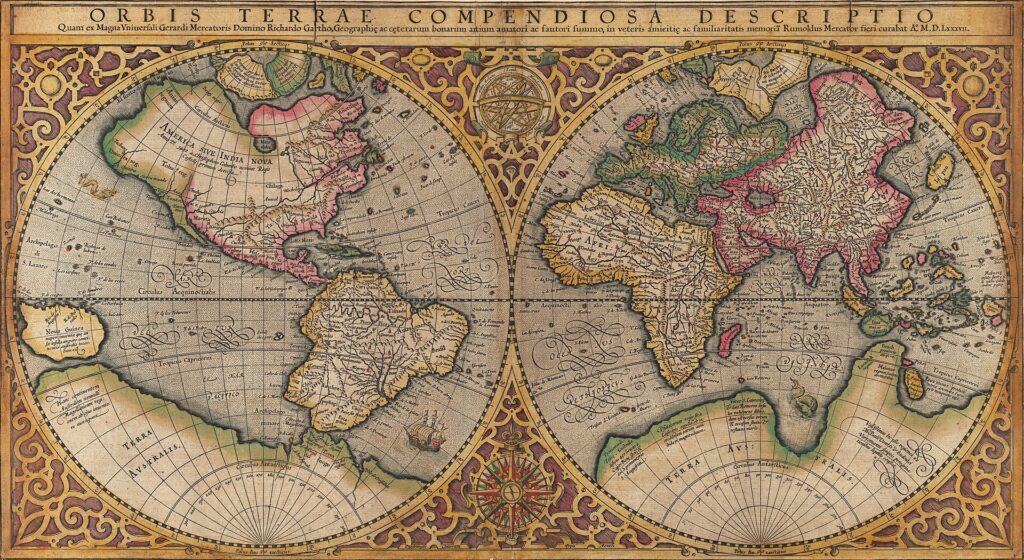
The Mercator projection, drawn in 1569, helped sailors chart straight-line courses. It was never meant to represent the world’s true proportions. It did one anyway. Hung in classrooms, embedded in software for four centuries. The distortion was not subtle. It’s easy to call this an accident of geometry, but it becomes harder to explain why these accidents always seem to inflate the same nations.
“Maps shape our understanding of the world. They guide education, nourish the imagination, and influence collective perceptions”
Robert Dussey, Togo’s Foreign Minister
This was never about Mercator’s maths. It’s about whose scale gets treated as neutral. France’s foreign minister, Jean-Noël Barrot, noted that the U.S., Russia, and China take on a disproportionate visual prominence compared to Africa and Latin America. An admission from a former colonial power that the “objective” map was never quite so objective after all.
The lone dissent came from Washington. “Instead of focusing on genuine problems of international peace, prosperity or good relations, this body is debating map projects from the 16th century – Yaryna Ferenceych, U.S. deputy representative. It’s a telling objection. Not that the map is accurate, but that accuracy shouldn’t be the UN’s concern.
None of this changes a single coastline. The resolution doesn’t ban Mercator and certainly doesn’t cost a government anything to ignore. What it does do is strip the old map of its unearned neutrality, and dare the rest of the world to notice how much that neutrality was shrinking a continent in plain sight.
