


This year marks two-hundred years since the opening of the Stockton and Darlington line, widely accepted to be the world’s first modern railway. Celebrations have taken place both in the North East and in the soon-to-be home of Britain’s new nationalised operator in Derby. However, both of those are a bit of a trek from here, so I decided to explore some more local rail heritage instead.
The most flexible way of exploring Devon by rail, as I have recently discovered, is the Devon Day Ranger ticket. This entitles the adventurous passenger to unlimited train travel across the county outside of peak hours, which, if you go for a Saturday like I did, means no restrictions whatsoever.
This being the British railway system, however, this ease of use is somewhat counterbalanced by the difficulties I encountered whilst trying to purchase it. Using either the South Western Railway or Great Western Railway sites, it is theoretically possible to order a physical ticket, which will then arrive by post. However, as I was looking to buy my ticket the evening before travel, this was not very feasible (Royal Mail have their limits). In the absence of any e-ticket alternative, I was forced to take the old-fashioned approach and find a ticket office the next morning (ticket office opening times for all stations available at National Rail).
Exeter Central is a quiet place early (well, eight in the morning) on a Saturday. There was only one other person in the station when I arrived, and he was only there to repair a broken ticket machine (ironically enough). Fortunately for me, he was also responsible for selling tickets, and – to my pleasant surprise – it only took him about thirty seconds to open the ticket office and print a Day Ranger, despite its apparent obscurity. One staircase and £11.30 later (£17 for those without railcards), I was onboard my first train of the day.
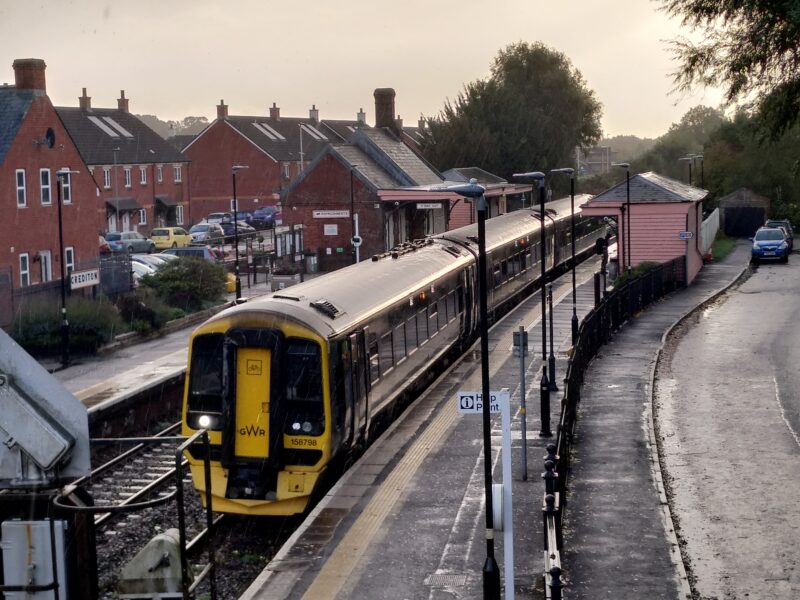
My next move was to get off this train again as I realised that I hadn’t checked where it was going. The destination on the board was Barnstaple, which while possessing a great deal of railway history and a café, is ninety minutes down the line (and, having planned for a railway café breakfast, I wasn’t sure my stomach would make it). The plan therefore was to alight at Crediton, explore the restored station and small museum, where I would then change onto an Okehampton train (and thence to breakfast).
At 0813 I departed, first heading downhill towards St David’s station. This line, opened in 1862, was once part of the London and South Western Railway from London Waterloo, competitor to the original Great Western (connected to today’s GWR in geography alone, despite what their marketing would have you believe) and their services from Paddington. Originally Exeter’s two stations were not connected – they were run by separate companies, after all – but plans made by the L&SWR to extend northwest ultimately led to a link line being constructed.
The next station, the first major stop on this north-western extension, is Crediton (arrived 0831), which is smartly painted in L&SWR pink and brown. Today it is the junction station for Barnstaple and Okehampton, both of which are single-track branch lines. To ensure that only one train is on each line at a time (and thus avoid accidents), Victorian railway operators developed a system of tokens, still employed today. To enter either the Barnstaple or Okehampton lines, a driver must be in possession of the correct token – they then take this to their destination and, upon returning to Crediton, hand this back to the signaller ready for use again. The process may be witnessed from the footbridge – I almost missed it, however, as I was distracted by the station’s overly-friendly cat.
The line from Crediton to Okehampton does not hide its previous guise as a heritage railway (it operated as such from the 1990s until the pandemic) – the traditional ‘clickety-clack’ of the rails is very audible, and the train rocks about at speed. Okehampton station, like Crediton, also wears old railway colours, this time those of the Southern Railway. This company’s creation was the result of a 1921 government act, designed to form a more organised railway network, by simplifying over one hundred private companies into just four: the SR, the LMS (London, Midland and Scottish), the LNER (London and North Eastern), and an expanded Great Western. One of the Southern’s flagship services was the Atlantic Coast Express – the nervous passenger’s nightmare, this train divided in four places, with the front coaches eventually ending up in Plymouth after taking the now-closed route to the north of Dartmoor, from Okehampton via Tavistock. Information on this train is available in the small exhibitions at both Okehampton and Crediton stations.

However, it was now 0916 and my stomach was calling. I thus made for the café, which partially occupied what was once the ticket office. Plenty of old equipment is still present, and provides a welcome distraction when travelling, as I had, during a large storm (as this tends to prevent the exploration of the outdoor areas of a station). Once the torrent had subsided, I had a couple of options. Further down the route of the old Plymouth line lies Meldon Viaduct, one of only two remaining wrought iron viaducts in Britain. The small station at Meldon, a part of the former heritage operation, also survives there, though disused. However, given the large poster in the café selling Okehampton as the gateway to Dartmoor, it would have been rude not to trudge up the steep hill for some moorland views. They were indeed lovely, but the weather had changed its mind, and I had barely made it back to the station before the heavens opened once again. As my train headed back towards Exeter, I caught sight the footbridge, a reminder of the danger of such storms. Upon reopening to main-line trains, this footbridge had a roof – however shortly afterwards, in high winds, it ended up falling onto the track (fortunately avoiding people and trains, but shutting the line).
After blasting past a new station under construction just east of Okehampton (the volume of housing going up nearby makes me think this will be a great success), and a quick change of trains at St Davids, I joined the Great Western line – this predates the L&SWR line by two decades, and is one of the most scenic in the country (even in today’s miserable conditions). It is also one of the most unusual, as it was designed to be operated by stationary steam engines located in pumping houses along the line, which would pump air out of a large metal pipe positioned between the rails. Carriages would have pistons fixed to their underframes, which would slot into the pipe, causing a train to be pulled forward by the difference in air pressure. The engineer, a certain Isambard Kingdom Brunel, pursued this technology as he believed that the steam locomotives of the day would not be able to climb the hills beyond Newton Abbot. The ‘atmospheric railway’ operated for a couple of years before reliability issues surrounding the leather pipe seals forced conversion to steam operation. Many pumping houses remain, such as the one at Starcross which stands opposite a pub named in this unusual railway’s honour.
The weather had actually begun to clear when I passed Dawlish, home of some of one of Devon’s stations most vulnerable to storm conditions. Extensive rebuilding work has taken place after the track and sea wall were completely washed away in 2014, but trains still pass along Brunel’s route to this day beneath the sandstone cliffs, exposed to the elements. And I do mean exposed – my aunt went past Dawlish on a train recently with the window open, and got a soaking from a large wave!
Perhaps down to troublesome weather conditions further up the line, my train arrived in Devon’s largest city (Plymouth) a little later than planned, at 1223, giving me only forty seconds to catch my connection. I just about made it – which was fortunate, as the next train up the Tamar valley (towards my next destination) wasn’t for another two hours. It was a surprisingly busy train – perhaps everyone was heading to the same place as me, the heritage centre at Bere Ferrers…
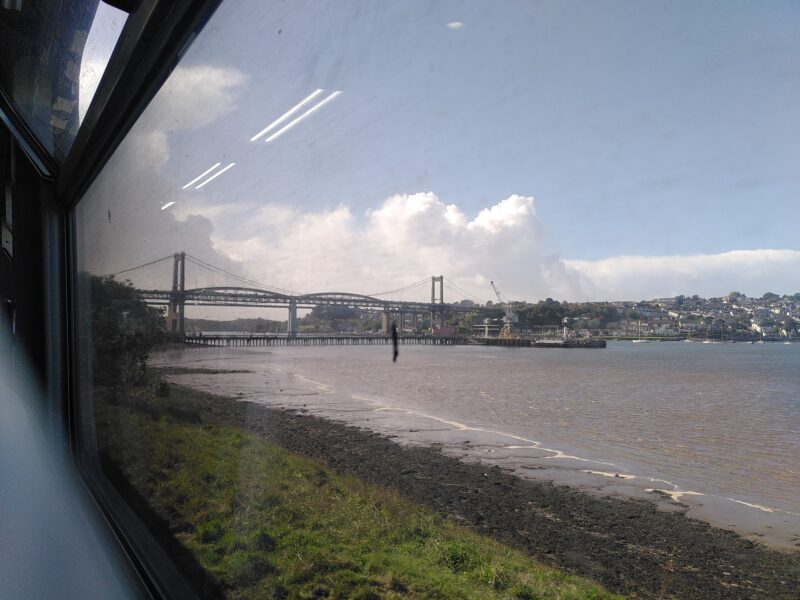
The Tamar valley also has some lovely views, of both natural (the train follows the river Tamar closely, crossing many smaller waterways) and human-made (the viaduct at Calstock – best viewed from the village down below – and Brunel’s Royal Albert Bridge linking Plymouth to Cornwall). However, one thing it didn’t have was an open heritage centre. Perhaps this was weather-related too. Much was visible from the platform, however, including an old signal box (salvaged from Pinhoe station) and several small locomotives and wagons. This begged the obvious question: if not to the heritage centre, where were all those train passengers going? I decided to head into the centre of the village to find out, and was greeted by an enormous sign reading ‘ANNUAL APPLE PIE COMPETITION: TODAY’. A pity I hadn’t known about this earlier… I could have made something. Never mind though, there was plenty to enjoy, including both solid and liquid apple products available for consumption…
After not spending the rest of my time in Bere Ferrers drinking cider (I was exploring the old quay – it’s a wonderfully calm spot), I headed back towards Plymouth. This line formed the other half of the L&SWR’s line from Exeter – trains heading north today leave this route at Bere Alston to terminate at Gunnislake in Cornwall. A legacy of this is the odd track layout at Bere Alston, which made perfect sense when through trains to London ran, but now forces every Gunnislake train to reverse before continuing its journey.
I changed trains again in Plymouth at 1415 – again, too briefly, I must come back and visit the lighthouse again some time – and once more headed to the coast, back to what the Great Western called the English Riviera (does that make Torquay our equivalent of Nice? I’m not sure how that name stuck either). My next stop, following another train change at Newton Abbot which almost ended in disaster as the catering trolley blocked my exit (and I nearly got carried back to Exeter), was Paignton. Is that Devon’s equivalent of Monte Carlo? I seem to remember hearing about a Torbay Grand Prix once…
What Paignton lacks in super yachts and millionaires, it thankfully makes up for in trains.
Anyway, what Paignton lacks in super yachts and millionaires, it thankfully makes up for in trains. The line continues south of here, but today’s main line trains do not, following the sale of the line in the 1960s. This was the era when so many of Britain’s railways, under full government control as British Railways since 1947 and facing increasing competition from road transport, were permanently closed following George Beeching’s infamous report The Reshaping of British Railways. The government of the day didn’t actually follow the report’s guidance to the letter, allegedly leaving some lines (such as the Heart of Wales line) open purely because they ran through several marginal constituencies, and ended up selling on the line beyond Paignton despite Beeching recommending that it stay open. Fortunately, the purchasers were the already established heritage railway at Totnes, who began operating steam services (BR having abandoned steam several years earlier) almost immediately to Kingswear, via Agatha Christie’s former home (now owned by the National Trust) Greenway (which had its own station, closed since the pandemic). A quirk of this particular line, preserved by its new owners, is that the terminus in the line’s name (The Dartmouth Steam Railway) has a station, but no railway connection to it. The story goes that admiralty objected to the construction of the final viaduct on the line – across the river Dart, just after Kingswear – but a station was built at Dartmouth anyway, and tickets to and from it were sold, which included the cost of a ferry connection to Kingswear. Dartmouth station building stands, looking a little lost, on the quayside to this day.
What all these changes of hands have meant is that, across the country, trains designed for one purpose have found themselves serving another completely different one, often in another part of the country
There was just enough time for some steam-train spotting before I had to board my next train (1540). This turned out to be a Networker Turbo (recognisable by its round yellow front with no end door), the ideal train for the weary traveller as – a legacy of some more recent railway history – it possesses a declassified first class section at either end, rewarding the knowledgeable passenger with a more comfortable seat and a larger table. These trains date from the 1990s, when British Rail began to be broken up, first into operating regions and then into privatised franchises. These franchises have since been reorganised several times and passed through the hands of many different companies – the Networker Turbos were ordered by the Network SouthEast division of BR and subsequently operated by Thames Trains, First Great Western Link, and finally the main arm of First Great Western (now operating as GWR, but still First Group underneath). What all these changes of hands have meant is that, across the country, trains designed for one purpose have found themselves serving another completely different one, often in another part of the country – as the Turbos have here, now operated without First Class, but retaining the different seating arrangement.

I had planned to take the ferry across the Exe from Starcross to Exmouth, but sadly the weather had put paid to that plan – I therefore headed the long way around via Exeter to reach my next stop, Topsham (1708). Once upon a time this little town was Exeter’s nearest port, and as such was a much busier place. The international design of the ‘Dutch houses’ is a relic of this time. Another is the strange railway-like footbridge spanning Holman Way, between the station and the old quay. This is what remains of the Topsham quay railway, whose route this road follows. The original warehouse by the river still exists, now an antiques centre, but the only trains this side of the station now are 1:76 scale, labelled Hornby Dublo and sold in the aforementioned antiques centre. The goods yard and second track to Exeter have also gone.
I think the highlights, however, were not the destinations themselves, but those views from the train window: the Exe in the morning, the Tamar in the afternoon, the waves crashing into the sea wall at Dawlish, Brunel’s Royal Albert Bridge at Plymouth… and I think this is really the strength of train travel as a whole.
Finally, I took a walk along the Exe to consider whether today had been a success. I hadn’t crossed the Exe by boat, and delays had meant that I hadn’t managed to see much of Plymouth – I hadn’t got to Barnstaple at all, Axminster was off the table from the beginning due to engineering works, and I hadn’t even considered Tiverton. And there wasn’t much more I could see that evening as it was getting dark. And quite windy again. However, I had seen quite a lot – maybe not what I intended (fewer heritage centres and boats, for example, but more apple pies), but interesting stuff nonetheless. I think the highlights, however, were not the destinations themselves, but those views from the train window: the Exe in the morning, the Tamar in the afternoon, the waves crashing into the sea wall at Dawlish, Brunel’s Royal Albert Bridge at Plymouth… and I think this is really the strength of train travel as a whole.
Whether driving (and focusing on that) or a passenger (and focusing on not being sick… perhaps that’s just a me problem actually), road transport, particularly motorway travel, does not quite bring the same sense of a journey as the train. And nobody has ever offered me a hot cup of tea while on the move on the M4. This could well be why train travel is having a resurgence – not so much by commuters, those who just need to get from A to B, but from adventurers who don’t mind spending an hour exploring a village, walking up a hill for a view, or sitting in a station café reading about how it used to be a ticket office. This makes the Day Ranger – available in all good counties, not just Devon – the ultimate train ticket, as it allows the passenger to meander wherever they wish (weather permitting), whether in search of history or hospitality. No two days on a Day Ranger can ever be the same, and I am already looking forward to my next trip on one – perhaps when the weather has cleared up a little…