


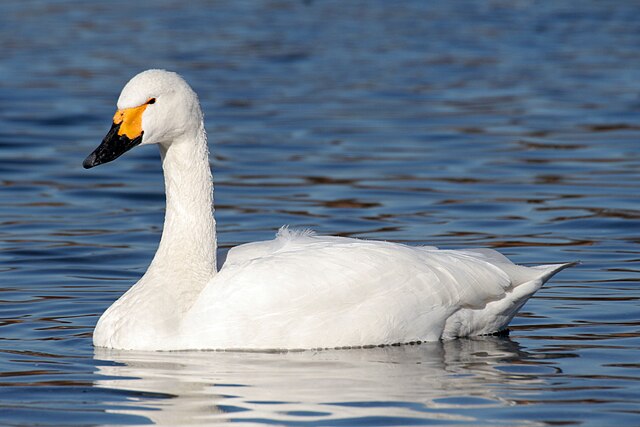
Each winter, our smallest and rarest swan species makes an epic journey from the Arctic Russian tundra to grace British wetlands. The Bewick’s swan is a charismatic winter visitor that, despite its challenges, continues to captivate birdwatchers across the country.
Adults are pure white with distinctive black and yellow bills, while juveniles appear greyish with pinkish bills. Remarkably, the yellow markings on each bird’s bill are unique (nature’s own fingerprint) allowing researchers to track individuals throughout their lives. Smaller than both Mute and Whooper swans, Bewick’s are roughly the size of a Canada goose with noticeably faster wingbeats. Unlike the curved neck of the Mute swan, they hold their necks straight. The key to distinguishing them from Whooper swans lies in the bill pattern: Bewick’s have proportionally more black and a rounded yellow patch, whereas Whoopers display a wedge-shaped yellow area.
Remarkably, the yellow markings on each bird’s bill are unique (nature’s own fingerprint) allowing researchers to track individuals throughout their lives.
Bewick’s swans favour eastern England and the Severn Estuary. Prime local viewing locations include RSPB Ouse and Nene Washes in Cambridgeshire, and WWT Slimbridge in Gloucestershire, where these remarkable birds have been monitored for over 60 years.
Climate change is altering the Bewick’s swan’s behaviour. Many birds are now “short-stopping” in central European wetlands rather than completing the journey to Britain, as milder winters mean they no longer need to travel as far to find ice-free habitat. This January, 20-year-old Galina arrived at Slimbridge for the first time, having previously wintered in Germany, the Netherlands, France, Poland, and Estonia, demonstrating both the species’ remarkable longevity and their reliance on protected wetland networks.
Unfortunately, the swan’s conservation situation is critical. Britain may have lost 43% of its Bewick’s swan population in just five years, earning them Red List status in 2021. Threats include illegal hunting abroad, lead ammunition ingestion, habitat loss, and climate impacts. Encouragingly, the UK’s 2025 ban on lead ammunition – following decades of campaigning – offers hope for these vulnerable travellers and the wetlands they depend upon.
