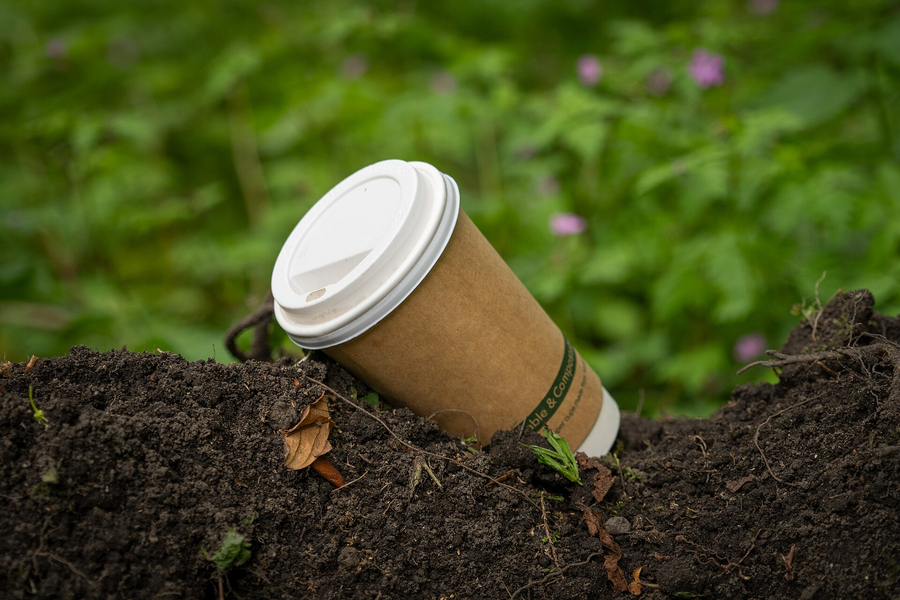

Growing awareness of the environmental damage caused by single-use plastics has led to a rise in biodegradable packaging. Marketed as a greener alternative to conventional plastics, materials such as polylactic acid (PLA) are increasingly used in products, including disposable coffee cups. But recent research suggests that biodegradable does not necessarily mean harmless.
Traditional plastics such as polyethylene (PE), polypropylene (PP) and polystyrene (PS) can remain in the environment for years. They can also release microscopic particles, including microplastics and nanoplastics, during everyday use. However, research conducted by ACS Food Science & Technology raised concerns through examining biodegradable alternatives that these materials may also release considerable quantities of particles.
The study found that paper cups lined with PLA released around 12 times more total plastic mass into hot water than cups lined with conventional PE. PLA-lined cups released approximately 11.6 micrograms of plastic per litre, compared with 0.9 micrograms from PE-lined cups. Nanoplastics were also significant, accounting for around 7.6 micrograms per litre.
Why might this happen? PLA is more brittle and less thermally stable than some conventional plastics. Exposure to hot liquids can cause the lining to swell, blister and then fragment. Rather than immediately breaking down chemically, the material can physically deteriorate and release microscopic particles. While PLA is designed to break down over time, the study found that it can instead fragment into smaller particles (microplastics and nanoplastics) when in certain conditions. This means that being labelled “biodegradable” does not necessarily mean the material will quickly disappear or avoid releasing microplastics.
So, for anyone buying a takeaway coffee, these findings raise an important question: does choosing a biodegradable cup actually mean less plastic exposure? The study suggests that under the hot-water conditions tested, PLA-lined cups can release more plastic particles than conventional PE-lined cups.
The study suggests that under the hot-water conditions tested, PLA-lined cups can release more plastic particles than conventional PE-lined cups.
Biodegradable packaging may still have environmental advantages in certain circumstances. However, the label alone does not guarantee that a product is environmentally harmless. So, for takeaway coffee drinkers, choosing a biodegradable coffee cup does not necessarily mean choosing a cup that releases fewer plastic particles.