


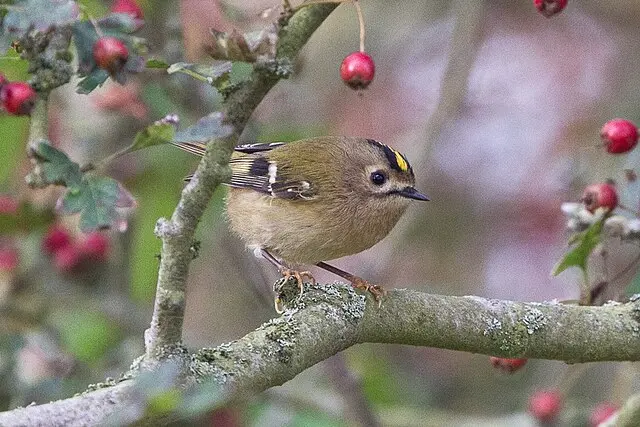
With a weight of 6g and wingspan of only 14cm, Goldcrests are easily identified as the UK’s smallest bird, along with the Firecrest. They have a dull greyish-green back, a pale belly, and a small black beak that is specially adapted to pick insects out from between pine needles. Interestingly, while all Goldcrests have a black and yellow patch atop their heads, only the males have an orange centre within the patch.
With a weight of 6g and wingspan of only 14cm, Goldcrests are easily identified as the UK’s smallest bird
Goldcrests can be seen all year in the UK, but are most commonly viewed in autumn and winter due to the arrival of birds from Russia and Scandinavia. A remarkable journey that meant early ornithologists did not believe that such tiny birds could make this migration across the North Sea, theorising that they must have ridden on the backs of the larger Woodcock. This myth has since been dispelled. Despite their surprising hardiness, Goldcrests are susceptible to the cold, meaning that numbers may fluctuate in particularly harsh seasons. Finding themselves most at home among conifers, large trees, and mixed woodland, they can be found in both urban and suburban areas. They eat small insects, such as spiders and moth eggs, using their thin beaks to great effect.
The Goldcrest have green conservation status, which means they are not threatened by extinction and are performing their ecological functions. They are in 790k territories and their population is rapidly expanding. Female Goldcrest lay up to 12 eggs at a time, which is one and a half times their bodyweight.
