


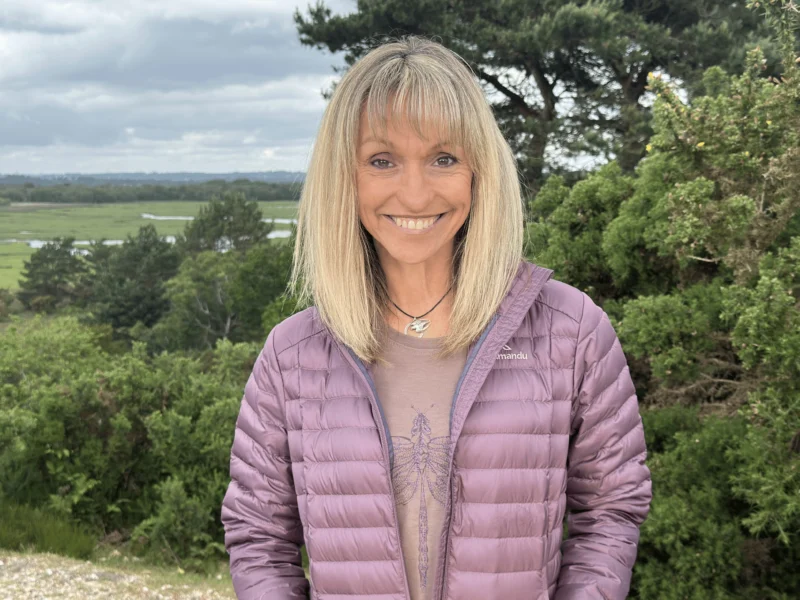
In an industry shaped by competition, persona and precarity, BAFTA-winning presenter Michaela Strachan is refreshingly blunt about what has kept her on British television screens for more than four decades: being herself and working hard at it.
Speaking with an ebullient Strachan over Zoom, she presented the same candour and spirit that have defined her forty-year career. There was little attempt on Michaela’s part to romanticise her journey or present it as a carefully planned success. Instead, she spoke with the assurance of someone well-equipped to adapt, and clear about what endures.
Her career, she explained, has “gone in lots of different directions.” Michaela began on Wide-Awake Club, a Saturday morning children’s show in the 1980s, while simultaneously presenting a late-night music programme with Pete Waterman, one-third of the songwriting trio Stock Aitken Waterman. Today, she is perhaps best known, particularly to younger generations, for her presence on British wildlife shows such as Countryfile and Winterwatch. Her career, however, has never been defined by a single genre but by her adaptability within a volatile industry.
“When you’re in the presenting world the most important thing is to be yourself” – Keeping it real in a volatile industry:
Throughout our conversation, one idea surfaced repeatedly: authenticity. It’s a concept that Michaela has identified as key to her longevity on television and a characteristic she holds to a high importance. While authenticity is often reduced to the hollow mantra of ‘being yourself,’ Michaela treats this cliché as a necessity.
As she puts it, “to try and be someone else, you can’t keep that up.” Her remark is simple yet captures an important truth: visibility in her industry demands consistency, but consistency is impossible when built on deception.
Authenticity, however, is not effortless. “There are a lot of people that think they can wing it these days,” Michaela shared in frustration. She rejects the notion that success can be built on charisma alone, enhancing the idea that authenticity is not an excuse to stop trying but a reason to try harder.
“I don’t just turn up and do it. I work hard. Don’t do something to the point it’s good enough, do it to the point it’s good… that’s probably a very good thing to say to university students.”
Michaela Strachan
“Everyone will sound the same, no one will have a unique personality” – What AI means for creativity and individuality:
Artificial Intelligence (AI) wasn’t something I had planned to raise, yet midway through the interview, Michaela introduced the topic herself. Our earlier discussion of authenticity appeared to resonate, prompting Michaela to instinctively link it to her wider concerns about AI and individuality.
“Don’t use AI all the time,” she said, cutting herself off mid-sentence. This resonated particularly with her son, a student at Loughborough University. “He had something to hand in today and told me he’ll put it through AI,” she shared. “I told him the trouble is that everyone will sound the same, no one will have a unique personality.”
Her concerns for her son and our generation weren’t rooted in academic performance, but in how AI is eroding the uniqueness of the human voice – the loss of thinking, shaping, and expressing ideas in our own voice. Everyone has a “unique personality and a unique way of writing things,” she explained. AI, she fears, strips people of the process that makes our personality so unique, and in turn makes us authentic – “If you want to be different to everybody else, use your own personality.”
“If you want to be different to everybody else, use your own personality.”
She turned to her long-term partnership with Chris Packham as evidence of how unique the human voice is – “Chris Packham and I work so well together because there isn’t anybody else like Chris and the way he says things, nobody would write the scripts that we do together.”
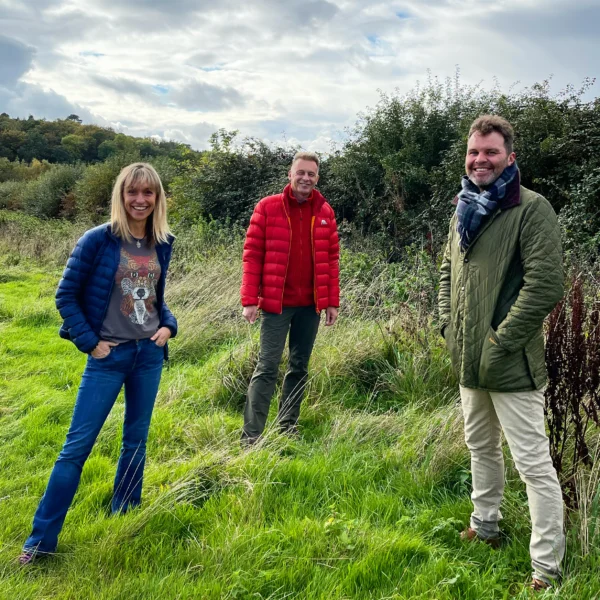
(Image – Andrewwaddison/Wikimedia Commons)
Michaela’s critique of AI is less about our engagement with technology, but rather the use of an individual identity. Individuality is what makes us unique and authentic, a recipe for success in all walks of life in her eyes, not just on television.
“Make sure you’re not preaching to the converted” – Communicating environmental urgency on television:
Having spent the majority of her career bringing wildlife into people’s living rooms, Michaela Strachan is acutely aware of the responsibility that comes with visibility. “Television is there to educate,” she told me, “But it’s also there to entertain.” With some reluctance, she described her work as “edutainment” – a term she admitted she “hates,” but accepts.
Striking that balance, she explained, is increasingly difficult. While climate change and wildlife conservation have dominated media discourse, she has observed that audiences disengage when urgency becomes overwhelming – “When we’ve gone down the road of educating people too much in the past, people switch off.”
“When we’ve gone down the road of educating people too much in the past, people switch off.”
Instead, she argues that environmental messaging must strike the perfect balance in a subtle way, immersed in entertaining storytelling – “You have to engage people and subtly get those points across whilst still entertaining them.” The real issue is not informing those who are already engaged with these issues, but those who are not already connected, stressing the importance that you need to “make sure you’re not preaching to the converted.”
“How do you get the people to watch that you need to educate?” she asked me. This question was directed towards the next generation of broadcasters; one she believes is a “challenge for you university students to take forward.”
“You need to realise how attached you all are with your phones and social media” – Disconnecting from a digital world:
When I asked how students might begin to engage with conservation and climate work, Michaela Strachan did not point first to activism. Instead, she returned to something far more familiar with our generation. “The biggest thing,” she said, “you need to realise how attached you all are to your phones and social media.”
It is a habit she notices most clearly through her son, who works in Sports Management with Oxford United Football Club whilst at university. Although his role is not desk-based, she explained, both his professional and academic life remain closely tied to screens. “His work involves his phone, his university involves his phone or his laptop,” she said, noting how quickly devices become our companions – “It becomes everybody’s go-to when they’re bored.”
For Michaela, meaningful engagement with nature begins with intentional disconnection. She spoke openly about the mental strain produced by constant digital immersion, suggesting that the stress many young people experience is inseparable from information overload. “We’re all bombarded with information all the time,” she reflected, arguing that learning to step away from it is not avoidance, but a necessity.
Her advice was simple and characteristically direct. “Take those AirPods out,” she urged. “You don’t need to educate yourself about every single thing in the world.” Instead, she emphasised the importance of mental rest, allowing the mind space to decompress rather than constantly consume. “Give your brain a rest,” she said, questioning how much of what we absorb is truly retained.
“Take those AirPods out. You don’t need to educate yourself about every single thing in the world.”
Ultimately, her message returned to the outdoors. Disconnecting, she suggested, is about restoring balance. “Get out into the world, let yourself calm down,” she advised. Only then, she argued, can people return to their work – academic, environmental, or otherwise – with clarity rather than exhaustion.
“I really enjoy live TV. What I do goes, and that’s what people see” – Excitement of her work forty years on:
After establishing the grounds for her longevity, I was keen to understand what excites her forty years on. To remain as a reputable figure in such a demanding industry, I assumed there must still be a spark of enthusiasm driving her career forward. Her answer was immediate: live television. After doing years of pre-recorded work, she finds repetition draining. “It can get a bit tedious when you’ve got to do ten takes,” she said.
Live broadcasting, in contrast, offers finality. “What I do goes,” she explained. “And that’s what people see.” Once again, authenticity shone through, this time in the form of risk, presence and irreversibility.
Now approaching sixty, she reflected sincerely on the competitive nature of the industry. “When you get to sixty, you’re not as competitive as you used to be,” she expressed. But rather than signalling decline, this shift has altered her engagement with work – “I can sit back a little bit more and just say, anything now is a bonus. I can sit back and really enjoy it.”
“When you get to sixty, you’re not as competitive as you used to be.”
“Take those risks that take you off the path of where you think you’re going”– Taking risks off the beaten path:
To reflect on the stories and experiences of the past forty years, Michaela Strachan will embark on a live theatre tour this year titled Not Just a Wild Life. The wordplay between “wild life” and “wildlife” is blatantly deliberate, capturing her professional focus and the broader experiences that have shaped her career. When I remarked on my appreciation of the title, she laughed, responding, “I’m glad a university student enjoys that.”

When the conversation turned to a philosophical reflection of the past forty years, Michaela spoke candidly about uncertainty – particularly for those still at university. Reflecting again on the guidance she gives her son, she emphasised the importance of remaining open to opportunity. “Always grasp opportunities, because you may have an idea of where your path is going in life and your career,” she said, “but you can’t really predict it.”
Her own career, she explained, is evidence of that unpredictability. “My career has not gone the way I thought it would have when I was twenty,” she admitted. At no point in her early career, she suggested, did she foresee herself presenting a BBC flagship programme about British wildlife. Even during her time on Wide Awake Club, such a path would have seemed improbable.
“My career has not gone the way I thought it would have when I was twenty.”
Rather than encouraging rigid ambitions, Michaela advocated for deviation – “Take those risks that take you off the path of where you think you’re going, because no one can really predict the path that they’re going to have.” For her, careers are never linear and pre-planned journeys but rather evolving routes, shaped by trial and error.
“I’ve been down quite a few cul-de-sacs in my career. I’ve come back, I’ve got on the path, I’ve gone again…” – Final reflections and advice for students:
Reaching for a metaphor, she depicted professional life as a network of roads – “Take the risk of taking the path less travelled, and if it doesn’t work out, you can always do a U-turn and go back and get on the motorway.” Even apparent dead ends, she suggested, hold value in the journey of life. “Even if it’s a cul-de-sac, take the cul-de-sac. I’ve been down quite a few cul-de-sacs in my career. I’ve come back, I’ve got on the path, I’ve gone again, and then I’ve gone on a lovely long road that’s taken me on a lovely detour around to get me back on the motorway that I’m on.”
It was, she concluded, the most important advice she could offer students today. In her words, there is no need to fear uncertainty, but rather to trust that progress is rarely straightforward – and the most meaningful paths and opportunities are often discovered by accident.
Michaela Strachan will appear at Exeter Corn Exchange on Thursday 16 April as part of her Not Just a Wild Life tour. Tickets and further details are available via the venue’s website.
